AlphaFold and AI Challenge Alzheimer's — After 20 Years Trapped by a Single Theory
Alzheimer's disease has resisted treatment for 30 years — largely because the 'amyloid mafia' monopolized science around a single hypothesis for decades. In 2022, key data from this theory came into question. Now AlphaFold and other AI tools are finding molecular targets previously invisible — and for the first time in twenty years, a genuine chance for breakthrough has emerged.
AI-processed from Habr AI; edited by Hamidun News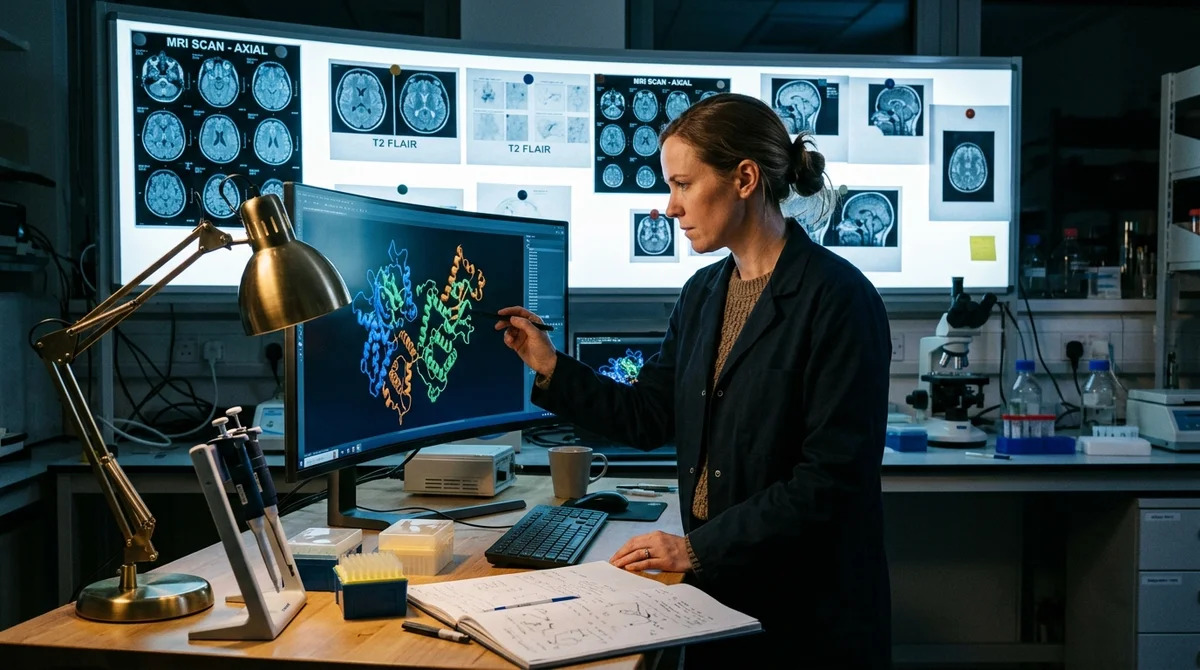
Alzheimer's and Parkinson's diseases remain among the most impenetrable in medicine — despite trillions invested and decades of research. The reasons are more complex than they appear: the path to treatment has been blocked not only by biology, but by science itself.
Diagnosis of Specific Cruelty
Terry Pratchett died in 2015 from posterior cortical atrophic syndrome — a rare form of early Alzheimer's that attacks not memory but the visual cortex. He saw a cup on the table, but his brain could not process that signal. A writer who built entire universes from images and words got a disease that took precisely that away.
"I'm scrambling along with others as fast as I can to keep up before the cure arrives," — from one of Pratchett's last public interviews.
He donated money to research, made documentaries and called the disease embuggerance — "a damned inconvenient circumstance." He didn't make it. And neither did many others.
Twenty Years Trapped in One Theory
Since the early 1990s, Alzheimer's research focused on the "amyloid hypothesis": the main cause of neuron death is plaques made of beta-amyloid protein. The idea proved fertile for careers and grants, but not for patients. An informal power structure grew around it — called the "amyloid mafia": scientific groups and editorial boards that promoted one paradigm and sidelined alternatives — the role of tau protein, neuroinflammation, mitochondrial dysfunction.
In 2022, a scandal broke. It turned out that key images in one of the most cited works — a study by Sylvain Lesné — could have been falsified. The paper that hundreds of subsequent studies relied on came under investigation by Science journal.
The hypothesis didn't collapse, but the monopoly began to crack.
The result of three decades: over a hundred failed clinical trials, billions in write-offs and a disease that remains impossible to stop or reverse.
How AI Changes the Rules
New tools attack the problem from multiple angles simultaneously:
- Protein structures — AlphaFold from Google DeepMind deciphered 3D models of millions of proteins, including those linked to neurodegeneration. Researchers find targets previously inaccessible to visualization.
- Early diagnosis — algorithms analyze speech patterns, eye movements and MRI data years before first symptoms appear. The accuracy of several systems exceeds 80%.
- Molecule search — AI models generate and test millions of drug candidates in days instead of years.
- Failure analysis — AI finds in the data of failed trials subgroups of patients who responded to treatment and proposes new hypotheses instead of burying results.
What This Means
AI has not found a cure for Alzheimer's. But for the first time in twenty years, there are tools that search for it correctly — without monopoly of one theory and with access to data that the human brain is physically unable to process alone. For millions of people who are now where Pratchett was, this is perhaps the most important news of this decade.
Need AI working inside your business — not just in your newsfeed?
I build production AI for companies — custom CRM, internal tools, autonomous agents, workflow automation. Owned by you, shaped to your process, no per-seat tax. Built by Zhemal Khamidun, CPO of AlpinaGPT (AI platform, 6,000+ users).
The AI world, distilled — once a week
Seven stories that actually mattered, hand-picked. No noise, no reposts, no press releases.
Done! Check your inbox for a confirmation.