Mistral launches physics AI for engineers: simulations in seconds instead of weeks
Mistral launched physics AI, a class of models that predict the behavior of physical systems in seconds instead of hours or weeks. It is built on the acquisition of startup Emmi AI. Instead of traditional numerical simulations (CFD, FEM) on HPC clusters, engineers get the full physical field in a single pass on a single GPU. This changes the design cycle: instead of dozens of iterations, thousands. The first partners are ASML, Airbus, Safran, and Siemens Energy.
AI-processed from Mistral AI News; edited by Hamidun News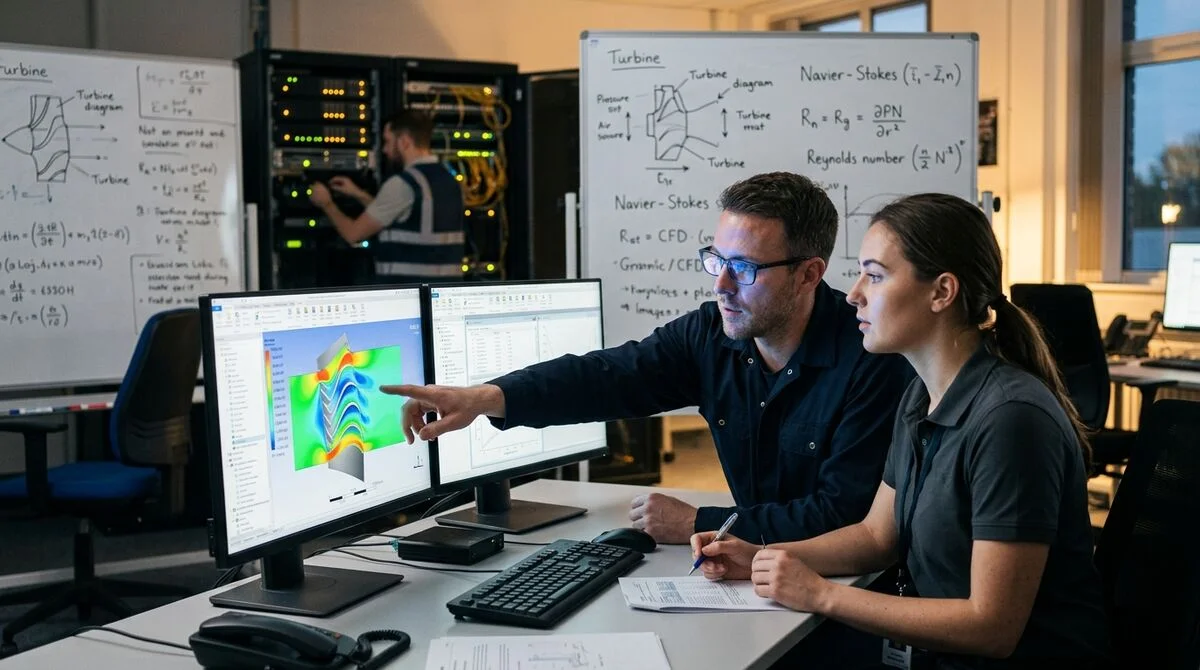
Mistral acquired startup Emmi AI and launched a new direction — physics AI: models that predict the behavior of physical systems directly from geometry and boundary conditions in seconds, instead of hours and weeks of traditional simulations. The company positions this as a fundamental shift in the speed of industrial engineering.
Why traditional simulations slow down development
Numerical physics simulations — CFD (computational fluid dynamics) and FEM (finite element method) — describe the world through partial differential equations: how fluid flows, how structures deform, how heat spreads. To solve them, engineers divide the object into millions of tiny cells and compute the behavior of each. The workflow in 2026 looks roughly the same as in 2006: CAD geometry preparation, mesh generation, boundary condition setup, job submission to HPC cluster, waiting.
One run takes from several hours to several weeks; licenses for commercial solvers and HPC cluster rental cost hundreds of thousands of dollars annually. As a result, teams test only a few design variants where mathematically it's possible to explore thousands. The optimal solution is too expensive in time and resources, so engineers settle for "good enough."
Each constraint — productivity, certification, cost — accumulates and multiplies at the next stage of the product lifecycle.
What is physics AI and how it differs from LLM
Physics AI is not a language model trained on a dataset of simulation results. It is fundamentally a different class of architectures with distinct objective functions and evaluation modes. The key point: the model predicts complete physical fields (pressure, velocity, temperature throughout the volume) in a single forward pass, rather than generating text token by token.
Key properties: One pass on one GPU — complete physical field in seconds Geometric generalization: one model serves an entire family of structures rather than retraining for each part Learns from outputs of traditional numerical solvers Does not fully replace traditional methods — they remain for verification and edge cases Mistral describes physics AI as a "jump in throughput": for most iterations in the design cycle, its accuracy is sufficient, and heavy solvers are only engaged for final verification.
Partners and their tasks
Mistral names specific industrial players: ASML (equipment for lithography in chip manufacturing), Airbus (aviation), Safran (aero-engines and safety systems), Siemens Energy (energy). All four critically depend on the speed of physical modeling — wing aerodynamics, heat transfer in turbines, mechanical stresses in the hull — and everywhere waiting hours translates to real money and shipment delays.
"Engineering ambitions have rarely been higher than today.
Defense readiness, energy transition, sustainable aviation, AI data center scaling, next-generation chips — all of this requires faster hardware development with smaller margins for error," states Mistral's announcement. Physics AI will enter the company's corporate solutions as part of a unified stack for industrial engineering: alongside language models, tools for agentic workflows, and secure deployment capabilities in customer infrastructure.
What this means
Major AI laboratories are moving beyond text and images: physical modeling is becoming the next frontier. For industrial companies, this potentially means transitioning from dozens of iterations per quarter to thousands — while maintaining physical accuracy and without proportional increases in compute costs.
Want to stop reading about AI and start using it?
AI News is a curated feed of AI/tech news. Hamidun Academy teaches you to use AI systematically in your work.
The AI world, distilled — once a week
Seven stories that actually mattered, hand-picked. No noise, no reposts, no press releases.
Done! Check your inbox for a confirmation.