Uber ends Waymo robotaxi partnership in Phoenix and seeks a new partner
Uber has officially ended its robotaxi partnership with Waymo in Phoenix, one of the main testing grounds for autonomous vehicles in the US. The companies were both partners and competitors at the same time: Waymo operates as a standalone service, while Uber wants to become an aggregator for all autonomous platforms. In its place, Uber says it will announce a new partner, whose name has not yet been disclosed.
AI-processed from Bloomberg Tech; edited by Hamidun News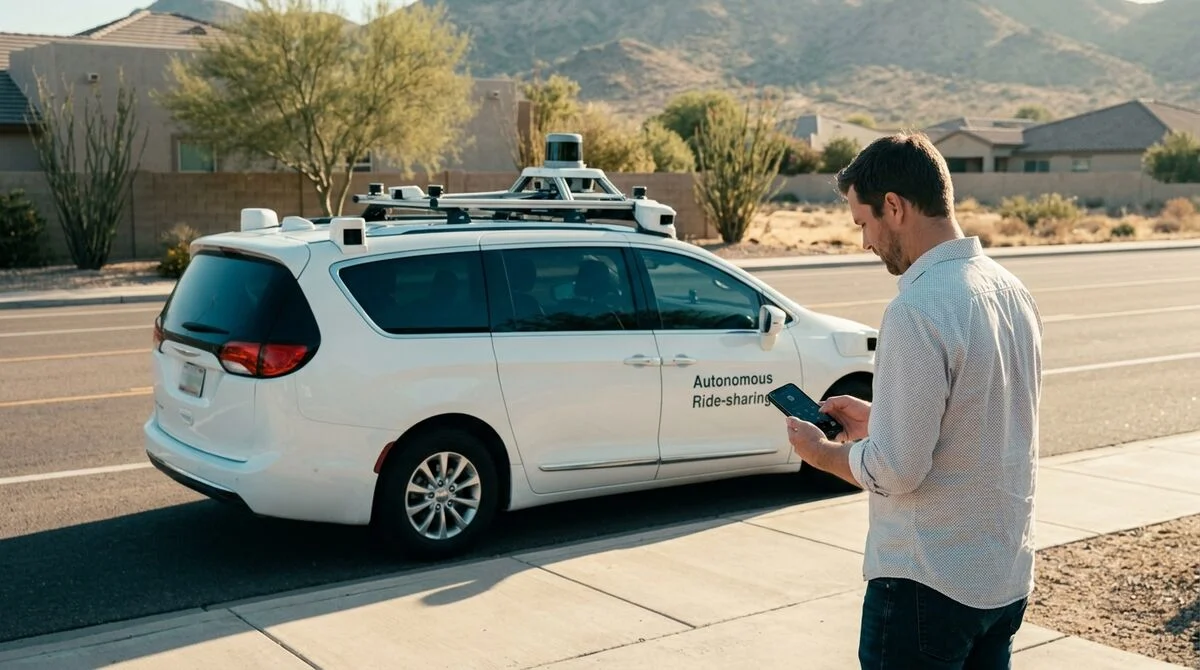
Uber has announced the termination of its joint autonomous taxi service with Waymo in Phoenix — one of the key US cities for testing autonomous vehicles. In exchange, the company is preparing an announcement of a new autonomous vehicle partner.
End of the Phoenix Experiment
The partnership between Uber and Waymo in Phoenix became one of the first major experiments in integrating autonomous vehicles into a mainstream ride-hailing app. Users could call a robotaxi directly from the familiar Uber interface without installing a separate Waymo One service.
Phoenix was not a random choice for such an experiment. Hot arid climate with rare precipitation, wide straight highways and relatively predictable traffic made it one of the most convenient testing grounds for autonomous driving. This is exactly where Waymo accumulated millions of miles and launched one of the world's first fully commercial robotaxi services without a safety driver behind the wheel.
Partners and Competitors at the Same Time
The relationship between Uber and Waymo has always been unconventionally arranged. On one side — cooperation: Waymo provided the fleet and autonomous technology, Uber — its customer base and developed payment infrastructure. On the other — obvious competition: Waymo One operates as an independent application and directly competes for passengers. This duality is typical for the entire industry at this stage. Autonomous platforms need traffic — aggregators provide it. Aggregators need autonomous driving technology — companies like Waymo provide it. But as robotaxi services gain scale, each player increasingly strives to control the end user.
Notably, the partnership in Austin and Atlanta remains intact — Phoenix became the first city where collaboration ended.
New Partner on the Horizon
Uber did not disclose the name of its next robotaxi partner in Phoenix, promising an announcement soon. The company is consistently building up the number of partnerships to avoid depending on a single supplier:
- Waymo (Austin, Atlanta) — partnership remains
- Motional and May Mobility — existing agreements in other cities
- Nuro — collaboration on autonomous delivery
- A number of European mobility startups
The strategy is obvious: become a neutral robotaxi aggregator — regardless of whose technology is under the hood. The more suppliers, the lower the dependence on any of them.
"We continue to develop partnerships with leading autonomous driving companies worldwide,"
Uber emphasized.
What This Means
The Phoenix breakup is not the end of Uber and Waymo relations, but a telling symptom. As robotaxi transforms from experiments into real business with hundreds of thousands of rides, the question of who owns the relationship with the passenger — the aggregator or the autonomous technology developer — becomes increasingly sharp. The answer will determine the balance of power in the industry for years to come.
Need AI working inside your business — not just in your newsfeed?
I build production AI for companies — custom CRM, internal tools, autonomous agents, workflow automation. Owned by you, shaped to your process, no per-seat tax. Built by Zhemal Khamidun, CPO of AlpinaGPT (AI platform, 6,000+ users).
The AI world, distilled — once a week
Seven stories that actually mattered, hand-picked. No noise, no reposts, no press releases.
Done! Check your inbox for a confirmation.