Flexion Robotics taught robots new skills without humans — only AI and simulation
Swiss startup Flexion Robotics developed a method for training humanoid robots without human involvement — using only AI algorithms and virtual simulation. Humanoids can run marathons and perform stunts, but their main value lies in routine industrial work. The method allows skills to be trained in a simulator and transferred to a real robot without costly instructors and annotators.
AI-processed from 3DNews AI; edited by Hamidun News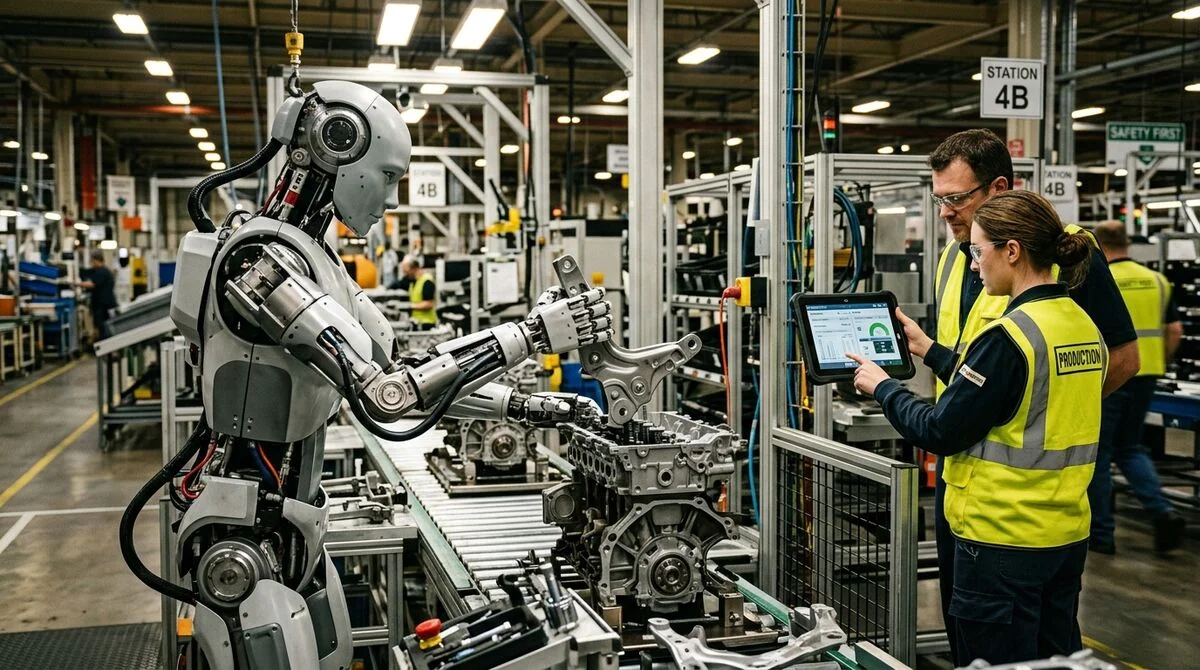
Swiss startup Flexion Robotics developed a method for teaching humanoid robots new tasks without human involvement. Instead of human demonstrators and data labelers — AI and virtual simulation.
Routine is more important than tricks
Modern humanoid robots can impress: they run marathon distances, perform on stage, demonstrate acrobatic capabilities. Videos with such tricks collect millions of views and create an image of "robots of the future," already living among people. But behind the spectacular demonstrations lies a more mundane reality: the real value of such machines is determined by the ability to perform monotonous, physically demanding or dangerous tasks — those from which people get tired, get injured or simply refuse. Assembly of components on a conveyor belt, packaging and sorting products, moving heavy cargo, servicing warehouse shelves — this is what humanoids are needed for in industry.
Teaching a robot each specific task is still expensive and time-consuming. The traditional cycle assumes human demonstrators, data labelers and verification engineers — the entire process takes months. Flexion Robotics set out to remove humans from this chain.
Simulation instead of an instructor
The startup's key idea is to move the entire training cycle to a virtual environment. AI algorithms independently generate thousands of variations of task execution, evaluate the quality of each attempt and iteratively correct the model's behavior. Live trainers and demonstrators are not needed — only a simulator and reinforcement learning algorithm. Advantages of the approach:
- Scaling without hiring and training a team of data labelers
- Safe training on dangerous, rare and non-standard scenarios
- Parallel mastery of multiple skills simultaneously
- Reducing the cycle from task definition to a ready skill by several times
- Reducing the cost of preparing each new skill
After training in the simulator, the system transfers the developed strategies to the physical robot — this process is called sim-to-real transfer. Historically, the most serious problems arose here: behavior in the simulator often diverged from reality due to inaccuracies in the physical model, differences in surface friction and material response. Flexion Robotics calls the accuracy and stability of this transition a key competitive advantage.
Competitors and context
Synthetic training of robots is one of the hottest topics in the industry right now. Google DeepMind, Physical Intelligence, Figure AI, 1X Technologies and dozens of other startups are conducting research in the same direction. Most of them rely on either large datasets with human involvement or expensive interaction with the real environment. Flexion Robotics is betting that a fully automated pipeline will allow deploying robots where it was previously economically infeasible: small production lines, regional logistics, food industry, agriculture. If the method proves effective in real conditions, the economics of robotics could change fundamentally.
What this means
Removing humans from the training cycle means making robots quickly adaptable to changing tasks and widely available. If Flexion Robotics achieves stable sim-to-real transfer in practice, companies will be able to launch new robotic operations in weeks instead of months. Industrial automation will no longer be a privilege of large corporations with multimillion-dollar budgets.
Want to stop reading about AI and start using it?
AI News is a curated feed of AI/tech news. Hamidun Academy teaches you to use AI systematically in your work.
The AI world, distilled — once a week
Seven stories that actually mattered, hand-picked. No noise, no reposts, no press releases.
Done! Check your inbox for a confirmation.