Alibaba unveiled AI models for robots — China is betting on agents
Alibaba has released its first set of AI models for robots — and this is not just a new product, but a sign of shifting priorities across China’s tech sector. The industry is moving from chatbots to agents: systems that do not answer questions, but carry out tasks in both the digital and physical world. Alibaba is betting on exactly this transition, building on its own logistics infrastructure with thousands of robots in warehouses.
AI-processed from TNW; edited by Hamidun News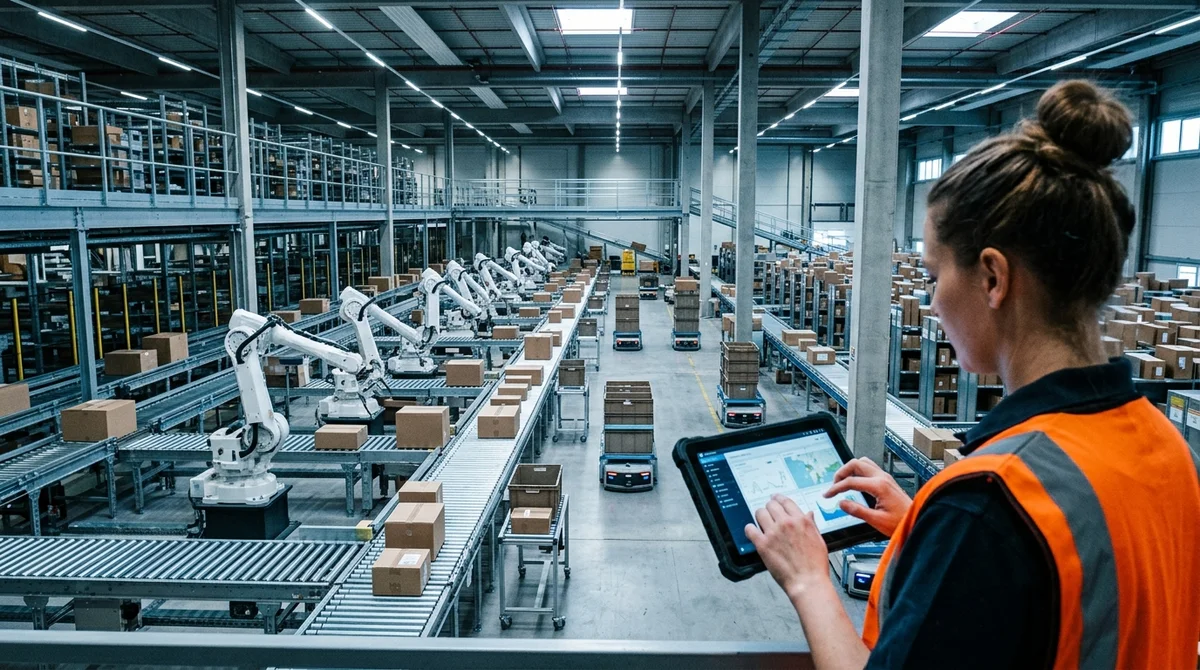
Alibaba presented its first set of AI models specifically for robots — and this step speaks not so much about the specific product, but about a global pivot of the Chinese tech sector: from dialogue systems to agents capable of acting in the physical world.
From chatbots to agents
The industry is experiencing a paradigm shift. Chatbots like ChatGPT answer questions — agent systems perform tasks. The difference is colossal: an agent can independently launch applications, control a browser, call APIs, interact with robots and make decisions throughout a long chain of steps without human participation. This transition is now shaping the agenda for the world's largest technology companies.
Alibaba, like Google, Microsoft and OpenAI, is betting on the agent layer — but with one significant difference: the Chinese company is immediately bridging the gap to the physical world through robotics. This is a logical step for an ecosystem that controls the world's largest e-commerce and logistics.
What Alibaba presented
A package of AI models for robots — the company's first such release and one of the first on the Chinese market. It is oriented toward a wide range of industrial and logistics applications. Key stated characteristics:
- Models adapted for controlling physical systems in real time
- Support for multi-step tasks and action planning in dynamic environments
- Integration with agent platforms and Alibaba Cloud infrastructure
- Focus on warehouse logistics, manufacturing and service robotics
- Ability to fine-tune for specific types of equipment and scenarios
Alibaba has a direct incentive for such developments: in its Cainiao logistics network, thousands of robots work in warehouses throughout China. Internal application allows the company to refine models on real data and operational conditions, and then offer them to corporate customers as a ready-made industrial solution. This is a classic approach: implement internally first, then sell to the market.
Why China is betting on agents
The Chinese technology sector has noticeably shifted its focus. After the initial race for language model parameters — and especially after the emergence of DeepSeek, which showed that expensive scaling race is not necessary for competitive results — the industry has reoriented toward applied AI. Main directions: agents, robotics and industrial automation.
Agents and robotics fit into China's state priorities: the "Made in China 2025" program stimulates industrial robotization, and a huge domestic market provides scale for rapid deployment. Alibaba, Baidu, Huawei and ByteDance are not competing on academic benchmarks — they are rushing to occupy positions in real industrial scenarios.
"The next major AI cycle is not the most powerful model, but the most
useful agent," — this is roughly how industry analysts formulate the overall strategic bet.
Additionally, China has a structural advantage in robotics: a mature manufacturing infrastructure, high enterprise readiness for automation, and regulatory support for industrial AI. This creates a market significantly more receptive to deployment than in many Western economies. Companies that first deploy reliable agent systems in industrial contexts will gain an advantage that is extremely difficult to overcome — especially in the enterprise segment, where changing suppliers is painful.
What this means
Alibaba is making a long-term bet: AI models for robots today — this is infrastructure for the agent economy of tomorrow. The industry is increasingly convinced that the next major AI growth will be not in chatbots, but in agents embedded in real workflows — physical and digital simultaneously. For the global industry, this is a signal: the Chinese technology sector is no longer playing catch-up, but is shaping its own agenda in agent AI and robotics.
Need AI working inside your business — not just in your newsfeed?
I build production AI for companies — custom CRM, internal tools, autonomous agents, workflow automation. Owned by you, shaped to your process, no per-seat tax. Built by Zhemal Khamidun, CPO of AlpinaGPT (AI platform, 6,000+ users).
The AI world, distilled — once a week
Seven stories that actually mattered, hand-picked. No noise, no reposts, no press releases.
Done! Check your inbox for a confirmation.