Anthropic taught Claude chemistry: Opus 4.7 outperformed specialized NMR software
Anthropic published a research blog on how Claude Opus 4.7 learned chemistry. NMR spectroscopy is the main method chemists use to study molecular structure. The study showed that Opus 4.7 handles NMR tasks on par with specialized software, and surpasses it in some tasks. This is the first time a general-purpose language model has competed with professional chemistry tools.
AI-processed from @AnthropicAI; edited by Hamidun News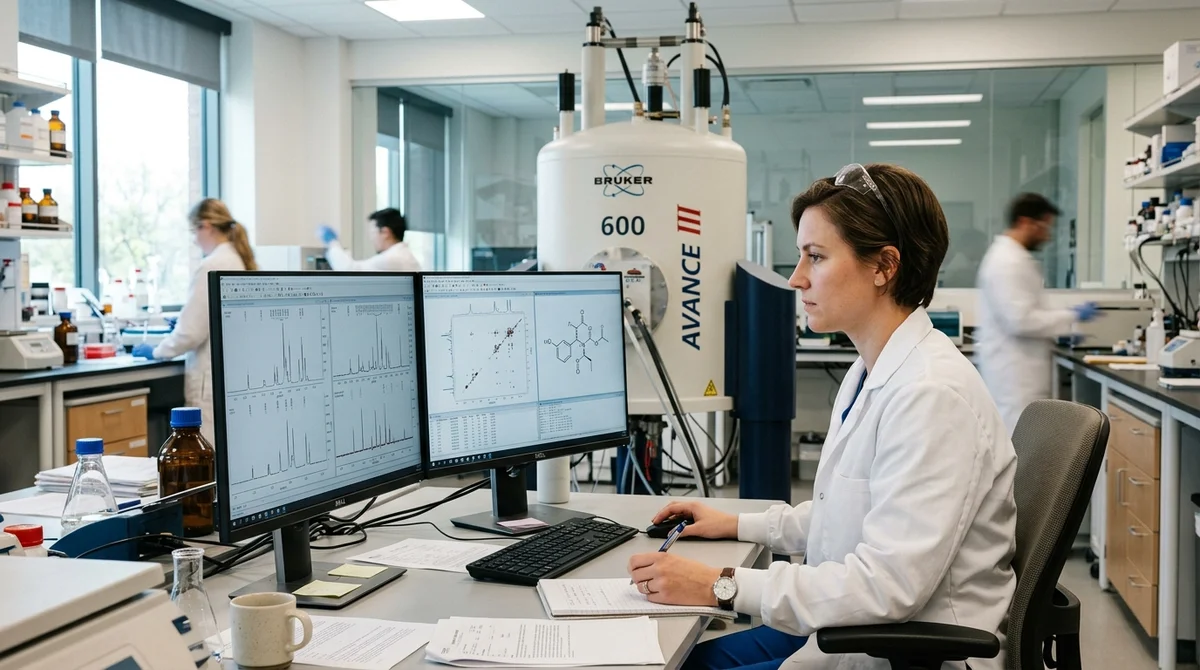
Anthropic Taught Claude Chemistry: Opus 4.7 Surpassed Specialized NMR Software
Anthropicpublished a new entry in its research blog about applying Claude Opus 4.7 to chemistry. The results are unexpected: the model handles NMR spectroscopy tasks on par with specialized software, and in some cases outperforms it.
Chemistry and NMR Spectroscopy
NMR spectroscopy (nuclear magnetic resonance, NMR) is a fundamental method in organic chemistry. It allows scientists to "look inside" a molecule and learn the arrangement of atoms, the type of chemical bonds, and spatial configurations. Without this method, it is impossible to develop new drugs, create polymers, synthesize specialized materials — and most fundamental research in organic chemistry.
NMR data looks like a set of peaks on a graph. Each peak corresponds to a specific atom or group of atoms in a particular chemical environment. Interpreting such spectra requires deep knowledge, years of experience, and understanding of subtle chemical effects. This is precisely why specialized software has been developed for years to automate this process.
What the Study Showed
AnthropicTested Opus 4.7 on standard NMR tasks and obtained unexpected results:
- On most tasks, the model showed results comparable to specialized NMR software
- In some assignments, Opus 4.7 surpassed traditional tools in interpretation accuracy
- The model successfully analyzed spectra, interpreted peaks, and predicted molecular structures
- Unlike specialized software, Claude explains its reasoning in natural language
Context is important: specialized NMR programs are developed over years by teams of chemists and engineers for specific tasks. Claude Opus 4.7 is a general-purpose language model that has not undergone specialized tuning for chemistry. This is precisely why the results look particularly impressive.
Why This Matters
"To manipulate a molecule, chemists first need to understand its structure.
Their primary tool is NMR spectroscopy," — says the Anthropic blog.
Claude's capabilities open several practical scenarios for science and education. In the research environment, this means reducing dependence on expensive licenses. Specialized NMR software often costs tens of thousands of dollars per year — particularly critical for small laboratories and universities in developing countries. An AI assistant capable of performing the same functions could democratize access to these tools.
For education, Claude's interactivity is a principal advantage. Traditional software provides an answer but does not explain it. A chemistry student learning spectrum interpretation can ask clarifying questions, request explanation of a specific peak, or compare two similar signals — and receive detailed answers in plain language.
What This Means
Claude's success in NMR tasks is part of a broader trend: language models are increasingly penetrating specialized scientific niches. If previously it was believed that AI would help with text and code but remain outside real science, these results suggest the opposite. The next step is integrating such capabilities into real laboratory workflows and possibly into the standard toolkits of chemists.
Want to stop reading about AI and start using it?
AI News is a curated feed of AI/tech news. Hamidun Academy teaches you to use AI systematically in your work.
The AI world, distilled — once a week
Seven stories that actually mattered, hand-picked. No noise, no reposts, no press releases.
Done! Check your inbox for a confirmation.