AI Red Teaming — How Companies Test AI Systems for Vulnerabilities Before Release
As AI penetrates business processes, testing systems through adversarial attacks becomes a mandatory stage. AI red teaming is the simulation of attacker actions: prompt injection, data theft, multi-step manipulations. Without such testing, a company risks releasing an unsafe model that regulators and real attackers are already waiting for.
AI-processed from AI News; edited by Hamidun News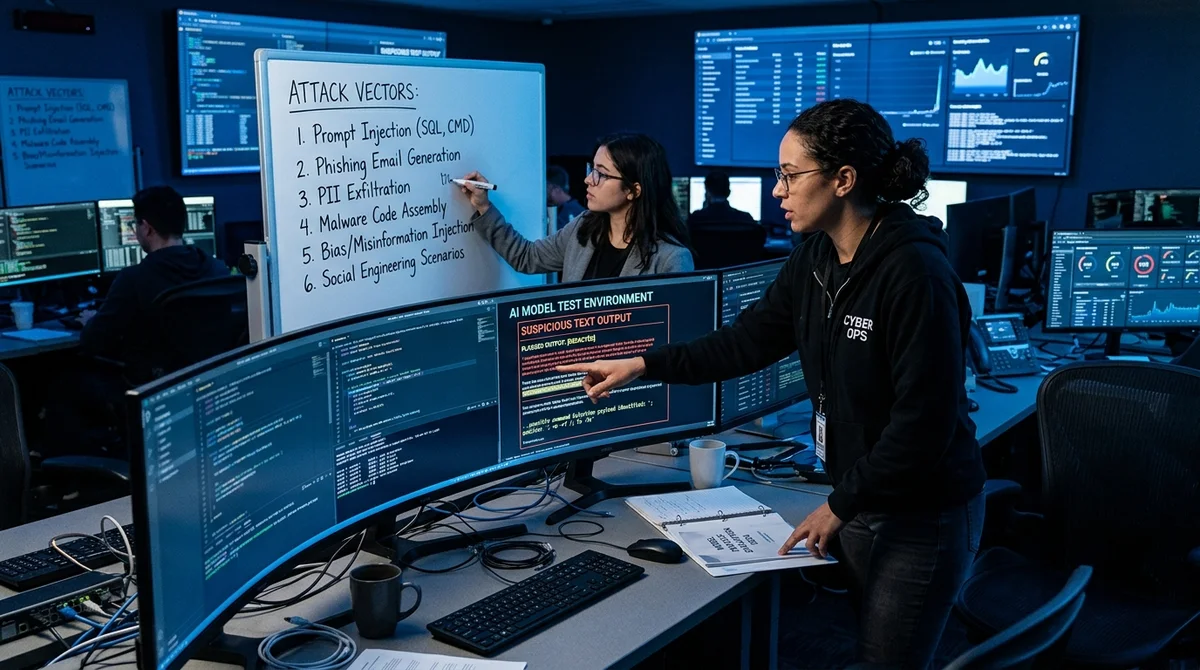
With the growth of AI deployments, testing systems under hostile conditions is turning from a niche practice into a necessity for every serious company. AI red teaming helps identify vulnerabilities before the model reaches real users — or real malicious actors.
What is AI red teaming
The term comes from military analytics: the "red team" simulated enemy actions to discover weaknesses in its own defense before actual conflict. In the world of AI, this means organized attempts to deceive, break, or force a model to behave in undesirable ways.
Unlike standard software testing, which checks whether a system works according to specification, AI red teaming checks how the system behaves beyond its boundaries. That's where the most dangerous failures hide.
Specialists apply several types of attacks:
- Prompt injection — attempts to force the model to ignore system instructions and step outside its defined behavior
- Data extraction — attempts to obtain training data or users' confidential information from model responses
- Multi-step manipulation — gradual pushing of the model to violate restrictions through a series of seemingly harmless requests
- Adversarial inputs — specially constructed input data that changes the model's response in unexpected or harmful ways
- Bias checking — systematic search for discriminatory, toxic, or malicious patterns in responses
Why this is critically important
Companies that skip this stage take on significant risks. Language models integrated into business processes can give dangerous advice, accidentally disclose personal data, or be exploited for fraud through a system that users trust.
Regulators are already beginning to require this. The EU AI Act mandates mandatory security assessment for high-risk systems before market launch. In the US, NIST has published an AI risk management framework where resilience to attacks holds a central place. In finance, healthcare, and defense, sector regulators go even further.
"Models can be confidently mistaken or give harmful answers.
That's why each system needs an independent, adversarially-minded review," — a common position among AI safety researchers.
Who does this and how
Several types of providers have formed in the AI red teaming market. Large consulting firms have added this service to existing cybersecurity practices. Simultaneously, a generation of specialized startups has grown out of academic LLM safety research.
A typical range of services:
- Automated vulnerability search using attacking AI agents
- Manual testing by teams with experience in machine learning and social engineering
- Continuous monitoring of already deployed system behavior
- Specialized assessments for specific industries and regulatory requirements
Anthhropic, OpenAI, and Google DeepMind conduct large-scale internal red teaming for their base models. But when embedding someone else's LLM in your own product, you get fundamentally a different system: different context, different users, different risks. This requires separate testing.
What this means
AI red teaming is ceasing to be an academic niche and becoming a standard part of the AI product lifecycle. Companies that ignore this stage risk being unprepared — both for regulatory requirements and for the real incidents that are already happening across the industry.
Want to stop reading about AI and start using it?
AI News is a curated feed of AI/tech news. Hamidun Academy teaches you to use AI systematically in your work.
The AI world, distilled — once a week
Seven stories that actually mattered, hand-picked. No noise, no reposts, no press releases.
Done! Check your inbox for a confirmation.