JetBrains Rethinks IDE: The Next Primary User Is an AI Agent
The mantra 'IDE is obsolete' sounds louder and louder: Claude Code, Codex, and OpenCode work directly in the terminal without complex interfaces. JetBrains disagrees — the company proposes rethinking the role of the development environment: the IDE is needed not for humans, but for AI agents. An agent with access to semantic analysis, dependency graphs, and IDE refactorings works more accurately than an agent with only a terminal.
AI-processed from Habr AI; edited by Hamidun News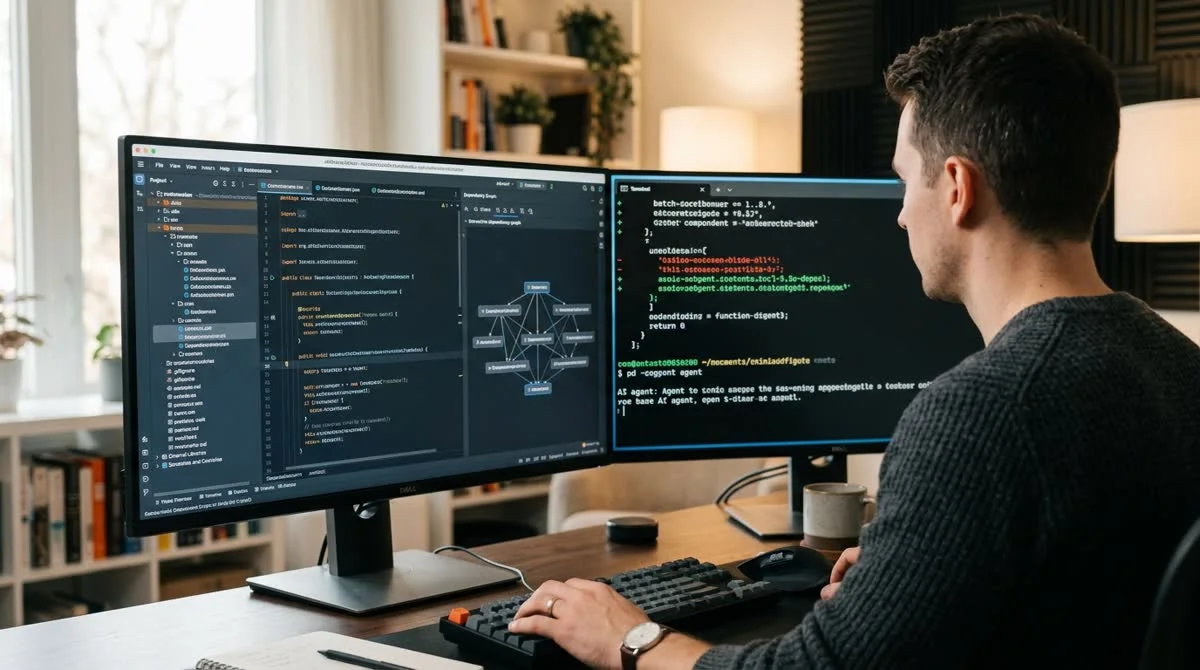
The OpenIDE team published on Habr an analysis of JetBrains' position in the debate about the future of the development environment: while part of the community declares the end of the IDE era, JetBrains proposes rethinking the question—the next principal user of the IDE will not be a human, but an AI agent.
Why the thesis "IDE is dead" is gaining strength
In recent years, a stable position has formed in the AI coding community: the professional development environment is outdated. Developers working with Claude Code, Codex, or OpenCode directly from the terminal explain the scheme like this: an agent needs enough grep, bash and edit plus a few good prompts. Complex interfaces, UI inspectors, built-in refactorings, and debuggers look like relics of the era of manual code writing.
The approach received an informal name "vibe-coding": development through intent rather than direct code control. Opened terminal, described task, got diff—no windows, no mouse click on menu.
In this picture, JetBrains is often portrayed as a dinosaur: a company that set the standard for professional tools for years, but now looks outdated with its AI Chat and Junie.
What the "terminal versus IDE" argument misses
This thesis has a fundamental blind spot: it looks at the development environment only through the eyes of a human. AI agents working through the terminal get access to code as text—without semantic understanding of project structure.
JetBrains formulate an alternative thesis: IDE is not an interface for humans, but an instrumental layer with deep knowledge about the project, which is exactly what an AI agent needs. What grep and bash cannot do by definition:
- Semantic code analysis with type and contract awareness
- Dependency graph between modules and symbols
- Safe refactorings that preserve invariants across the entire codebase
- Semantic navigation rather than line-by-line
- Direct integration with debugger, test runner, and build system
An agent with access to these tools through IDE makes precise changes—rather than guessing context from neighboring files.
Why IDE is needed by an agent, not just a human
JetBrains has been building AI integration for several years now in exactly this logic. AI Chat (formerly AI Assistant) and Junie place the agent inside the IDE rather than outside—giving it direct access to the structural tools of the development environment.
The OpenIDE team, which published the analysis, holds the same position: no developer they know has deleted IDE from their work computer, although AI agents are already used by everyone or almost everyone.
IDE remains the point at which both human and agent simultaneously get full project context.
"Today let's talk not about why IDE is needed by humans, but about why it's needed by an agent," said the
OpenIDE team on Habr.
What this means
The opposition "terminal versus IDE" risks being a false dichotomy. AI agents with access to semantic IDE tools work more accurately than those that only see text files. If JetBrains consistently implements this model, the development environment will not disappear—it will change its principal user.
Want to stop reading about AI and start using it?
AI News is a curated feed of AI/tech news. Hamidun Academy teaches you to use AI systematically in your work.
The AI world, distilled — once a week
Seven stories that actually mattered, hand-picked. No noise, no reposts, no press releases.
Done! Check your inbox for a confirmation.