Rosatom Announces Breakthrough: Russia Created Source of Quantum 'Squeezed' Light
Russia has mastered the technology of creating quantum 'squeezed' light — a special state of photons possessed by only a handful of countries globally. Rosatom announced this. The technology enables photonic quantum computers, secure quantum communications, and ultra-precise sensors — serving as a foundational platform for multiple areas of the quantum industry.
AI-processed from CNews AI; edited by Hamidun News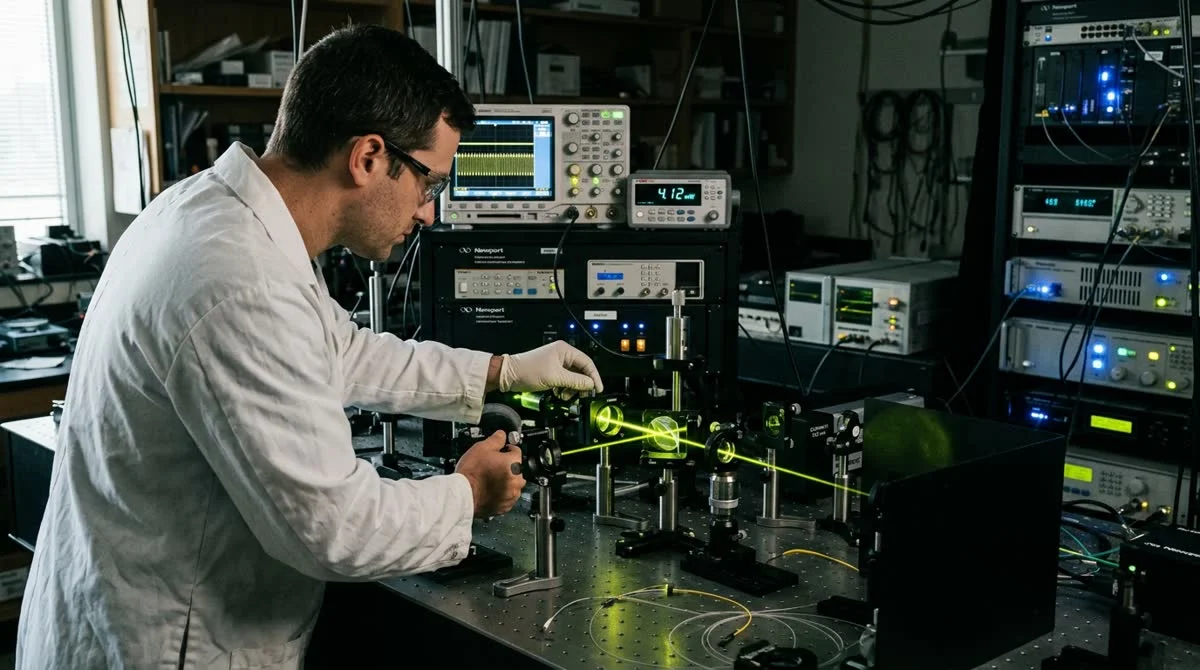
Russian scientists have developed a source of quantum "squeezed" light — a technology that, according to Rosatom, only a handful of countries possess. This new development opens prospects for advancement in several key areas of quantum technologies.
What is quantum "squeezed" light?
In quantum optics, "squeezed" light refers to a special state of the light field in which quantum noise of one measurable characteristic — for example, amplitude — is suppressed below the so-called standard quantum limit. This is possible thanks to Heisenberg's uncertainty principle: by reducing noise in one variable, we inevitably increase it in the conjugate (in this case, in phase). No violations of the laws of physics — only controlled redistribution of quantum uncertainties.
Creating such sources is a non-trivial task. It requires special nonlinear optical media (crystals or fiber structures), highly stable laser systems, and strict control over experimental parameters. That is why only leading scientific powers possess full technology of "squeezed" light.
Where is "squeezed" light applied?
"Squeezed" light is one of the fundamental resources for several quantum disciplines:
- Photonic quantum computers — special states of "squeezed" light are used as qubits or resources for correcting quantum errors in optical circuits
- Quantum cryptography (QKD) — allows building communication channels in which attempts at interception are physically detectable
- Quantum metrology — measurements of frequency, length and time with accuracy exceeding classical limits
- Quantum sensors — precision detectors of gravitational waves, magnetometers and gravimeters of a new generation
This explains why Rosatom characterized the development as a breakthrough in several directions at once: it is not about a specific device, but about a basic technology with a wide range of applications.
Context: Russia's quantum program
Russia is implementing a state roadmap for quantum technologies, in which Rosatom is one of the key executors for the quantum computing direction. Mastering the source of "squeezed" light eliminates dependence on foreign supplies of quantum-optical equipment — a critical element under existing technological restrictions.
The "club" of nations that truly possess sources of "squeezed" light and use them in scientific and applied tasks numbers only several countries: the USA, Japan, China and a number of European states. Russia, according to Rosatom, has now joined their ranks.
What this means
The achievement of Russian scientists is not a point result, but a strategic competency. Photonic quantum computing is gaining momentum in the global technology race precisely because photonic circuits do not require deep cryogenic cooling — unlike superconducting processors. Having mastered a basic component of this direction, Russia expands its own quantum roadmap and reduces dependence on imports in a strategically sensitive area.
Want to stop reading about AI and start using it?
AI News is a curated feed of AI/tech news. Hamidun Academy teaches you to use AI systematically in your work.
The AI world, distilled — once a week
Seven stories that actually mattered, hand-picked. No noise, no reposts, no press releases.
Done! Check your inbox for a confirmation.