Toyota to Apply AI for Systematizing Corporate Documentation and Terminology
Toyota Motor — pioneer of assembly line production — has embarked on AI-optimization of internal business processes. First task: bringing corporate documentation in order and unifying terminology that has accumulated over decades across hundreds of divisions worldwide. Project details — tools, partners, timelines — remain undisclosed.
AI-processed from 3DNews AI; edited by Hamidun News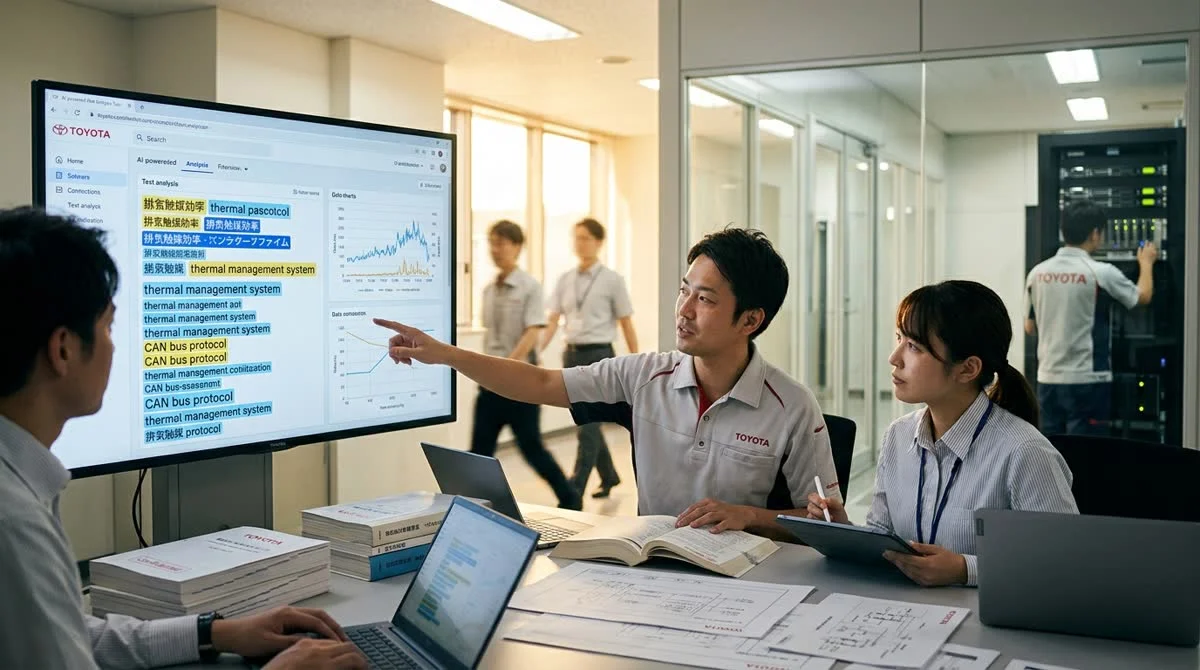
Toyota Motor — one of the world's largest automakers and a recognized pioneer of assembly line mass production — plans to leverage artificial intelligence to systematize internal documentation and standardize corporate terminology. The company acknowledges that opportunities for optimizing internal business processes remain significant and views AI as a tool to realize them.
Why Toyota Needs AI in Document Management
For a corporation with multi-billion-dollar revenue, hundreds of production facilities on several continents, and hundreds of thousands of employees, managing internal documentation is not bureaucratic formality but critical infrastructure. Fragmented regulations accumulated over decades of active growth, outdated technical instructions, and terminological discrepancies between divisions create invisible but tangible losses: they slow communication, generate errors on production lines, and complicate employee training.
The problem is exacerbated by company scale: Toyota's production sites are scattered across dozens of countries, and corporate documentation was created and edited by hundreds of teams over decades — often without unified terminology policy and central editing. The result is thousands of documents with overlapping content, contradictory formulations, and outdated definitions.
This is where the company sees AI's role: not to generate new documents, but to analyze existing text arrays — to identify duplicated or contradictory instructions, find outdated designations, and propose unified terminology solutions.
Why Terminology Matters for an Auto Giant
Production of a modern automobile is the integration of thousands of components, hundreds of suppliers, and specialists with different technical traditions. When engineers from different divisions call the same process or part by different names, it leads to delays, assembly errors, and costly rework. In a highly competitive global automotive market, such losses directly impact product cost and the speed of bringing new models to market.
Toyota is widely known for the Toyota Production System (TPS) and the philosophy of "kaizen" — continuous improvement. This methodology implies a constant search for and elimination of inefficiencies, including information-related ones. The application of AI to organizing documentation fits precisely into this logic: not revolution, but methodical, systematic optimization of what has accumulated over years.
In recent years, Toyota has actively invested in digital transformation of production — robotization, predictive equipment maintenance, and real-time analysis of conveyor data. Systematization of documentation with AI fits into this strategy as its necessary foundation: without a unified terminological space, data integration between divisions remains incomplete.
How AI Works with Corporate Documents
The AI task in this context is analysis, not creation. Modern language models are capable of processing thousands of pages of text in minutes: finding contradictions between regulatory versions, identifying inconsistent terminology use, classifying documents by relevance, and suggesting unified formulations. This task would require in manual mode a large editorial team for several months.
For a company of Toyota's scale, where documentation was historically created by different teams in different countries, such tools can save hundreds of person-hours and reduce errors caused by terminology confusion.
Large industrial corporations worldwide are increasingly turning to AI in precisely this context: not to create new, but to bring order to what has been accumulated.
What This Means
Toyota demonstrates a pragmatic view of AI: the company sees in it not only a tool for developing autonomous vehicles and optimizing supply chains, but also a way to solve a long-standing administrative problem — managing accumulated knowledge within a large organization.
Toyota's initiative is important as a precedent: one of the world's most methodical corporations publicly acknowledges that accumulated documentation has become a management bottleneck — and chooses AI as a tool to solve it. Specific timelines, technology partners, and tools being used have not yet been disclosed.
Need AI working inside your business — not just in your newsfeed?
I build production AI for companies — custom CRM, internal tools, autonomous agents, workflow automation. Owned by you, shaped to your process, no per-seat tax. Built by Zhemal Khamidun, CPO of AlpinaGPT (AI platform, 6,000+ users).
The AI world, distilled — once a week
Seven stories that actually mattered, hand-picked. No noise, no reposts, no press releases.
Done! Check your inbox for a confirmation.