California Pays Farmers for 'Green' Gas from Manure, But Math Doesn't Add Up
California has for years subsidized the conversion of methane from dairy cattle manure into 'renewable natural gas'. The program has become extremely popular — it actually pays farmers. But climatologists are raising an alarm: the scheme indirectly incentivizes increasing cattle herds, which means total greenhouse gas emissions may grow instead of declining.
AI-processed from MIT Technology Review; edited by Hamidun News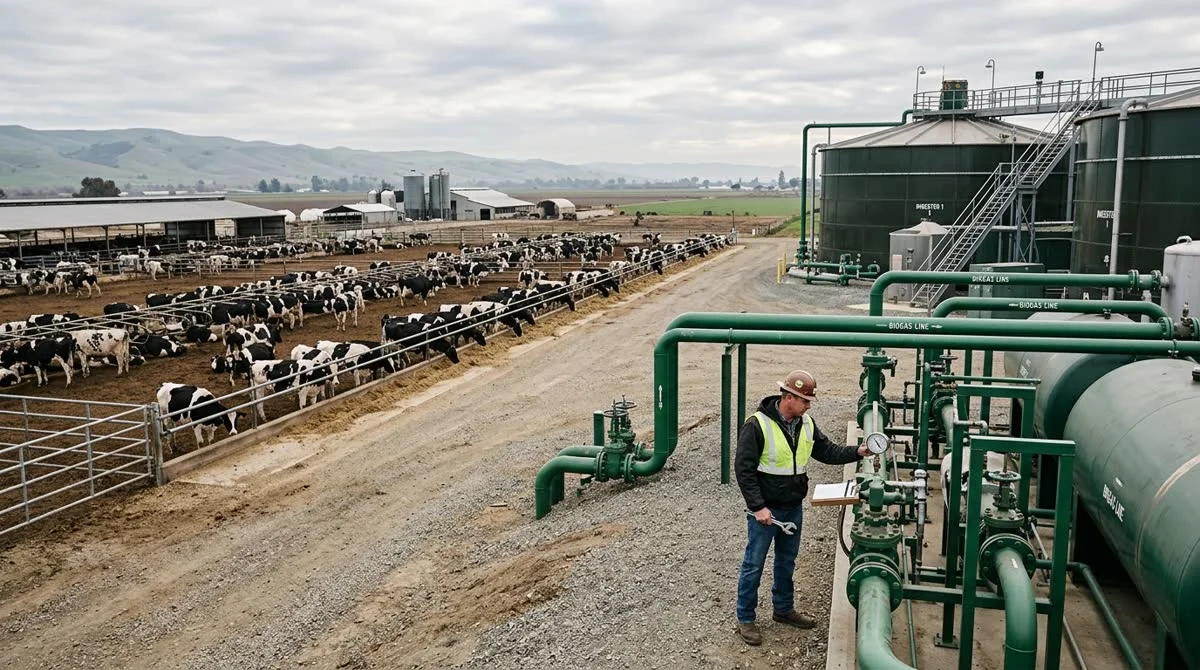
California has been subsidizing methane conversion from manure into "renewable natural gas" (RNG) for several years. An investigation by MIT Technology Review, published July 2, 2026, shows: the climate math behind this program doesn't add up — the scheme may actually stimulate emissions rather than reduce them.
How the LCFS program works
The mechanism operates through California's Low Carbon Fuel Standard (LCFS) credit system. Farmers install anaerobic digesters above manure lagoons that capture methane and convert it into natural gas for combustion. Oil and gas companies purchase these credits, applying them toward their own carbon compliance obligations to regulators.
Key detail: the program covers dairy farmers across the entire United States, not just California. The state essentially exports its climate scheme to the national level.
On paper, the logic is flawless: methane is roughly 80 times more potent than CO₂ as a greenhouse gas over a 20-year horizon, and capturing it from manure lagoons instead of releasing it directly into the atmosphere genuinely appears to be a climate win.
- Oil companies purchase LCFS credits to meet their carbon obligations
- The program covers dairy farms across the entire United States, not only California
- Methane from manure is officially classified as "renewable natural gas"
- The scheme became extremely popular precisely because it actually pays farmers money
Why the math doesn't work
The investigation's authors identified at least three fundamental contradictions.
Incentive to expand herd size. The program indirectly pays per cow: more animals — more manure — higher subsidies. But each additional cow produces enteric methane (from gut fermentation) — gas that digesters don't capture at all. As a result, the financial incentive to expand herds can completely erase the climate benefit from manure processing.
Unintended environmental consequences. Manure lagoons accumulate nitrogen and phosphorus, contaminating groundwater in surrounding areas. A digester solves one environmental problem without addressing the others — as farms scale up, these side effects only worsen.
Questionable accounting methodology. The carbon footprint of RNG is calculated through an "avoided emissions" concept: the assumption is that without the program, methane would escape into the atmosphere directly. But the gas ultimately gets burned anyway, and CO₂ ends up in the air — just later and in a different place. Some researchers argue the system issues climate credits where no actual emission reduction occurs.
"Something isn't right with
California's climate policy," conclude journalists who studied the program's mechanics up close.
What drives the popularity
The program became, in the authors' words, "wildly popular" — and the reason is obvious: it delivers real money to participants. The dairy sector gained a powerful financial incentive that ties it to "green" gas production. Alternative climate solutions — direct herd reduction, changes in livestock diet, transitions to different agricultural practices — become less attractive as long as stable subsidies flow for manure.
That, critics argue, is the scheme's core trap.
What it means
California positions itself as a global climate policy leader, and its LCFS standards are becoming a model for other states and countries. If the math behind one of its key programs doesn't hold — the validity of not only specific subsidies but also broader principles of accounting for "green" energy sources comes into question. The program's popularity and its actual climate effectiveness turned out to be different things — and the longer this is ignored, the steeper the correction bill will be.
Want to stop reading about AI and start using it?
AI News is a curated feed of AI/tech news. Hamidun Academy teaches you to use AI systematically in your work.
The AI world, distilled — once a week
Seven stories that actually mattered, hand-picked. No noise, no reposts, no press releases.
Done! Check your inbox for a confirmation.