Chip stock selloff spreads to South Korea as investors question AI rally
A wave of chip stock selloffs hit South Korea on July 2, 2026, with the KOSPI closing lower alongside global exchanges. Investors are once again questioning whether the months-long AI rally has gone too far. Declines swept markets from the US to Asia, with memory chip makers at the epicenter of the selloff.
AI-processed from Bloomberg Tech; edited by Hamidun News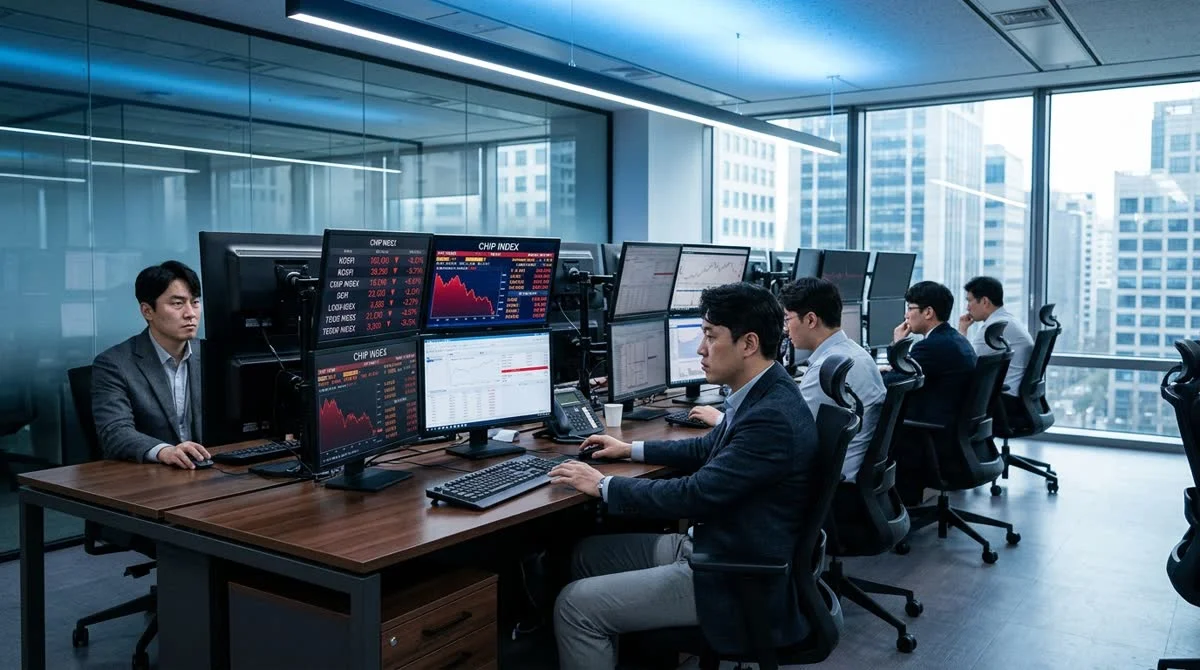
Chip-stock selloff spreads to South Korea: investors doubt AI rally
A wave of selloffs in semiconductor manufacturer stocks on July 2, 2026, spilled over to South Korea's stock market: the Korean exchange index KOSPI closed in negative territory alongside global exchanges. The decline renewed fears that months-long rally in AI stocks had gone too far.
How the selloff reached Korea
South Korea occupies a key place in the global semiconductor supply chain. Leading Korean chipmakers produce a significant share of global DRAM and NAND memory production, which is directly used in servers for training AI models. This is why the global wave of selloffs in the chip sector is instantly reflected in KOSPI: with any cooling of interest in semiconductors, tech stocks drag the entire index down. The decline spread across venues throughout Asia — following American exchanges, where the profit-taking wave started earlier. Investors were exiting positions that had grown confidently for several months on the wave of AI hype. Bloomberg analysts documented synchronized market movements from New York to Seoul.
Why are investors talking about overheated AI stocks?
Concerns have been mounting for a long time: AI stocks have consistently outpaced the broader market over several years. High-performance chip makers turned into the main beneficiaries of the AI boom — demand for computing power for training and inference of large language models hit record quarters in a row. Hyperscalers, cloud platforms and hundreds of AI startups were increasing GPU purchases and specialized accelerators, driving up valuations.
Skeptics pose the same question: when will the massive capital expenditures on AI infrastructure begin to convert into comparable profits? So far, there's no convincing answer, and the sector remains sensitive to any negative signal. The history of technology markets — from the internet boom of the late 1990s to the blockchain wave — shows: market optimism regularly outpaces actual financial results.
- A wave of selloffs swept global exchanges on July 2, 2026
- At the epicenter of the decline — chip maker stocks in the US and Asia
- South Korea suffered as the leading global supplier of memory for AI servers
- Investors are questioning: do current AI stock valuations match actual company revenues
What this means
Synchronized correction from American venues to KOSPI is a sign of global, not local, risk reassessment in the sector. The market is beginning to demand concrete evidence of AI monetization: stories of growth are no longer enough. The next quarterly reports from the largest tech companies will be the main test — will operational reality confirm current stock exchange valuations.
Need AI working inside your business — not just in your newsfeed?
I build production AI for companies — custom CRM, internal tools, autonomous agents, workflow automation. Owned by you, shaped to your process, no per-seat tax. Built by Zhemal Khamidun, CPO of AlpinaGPT (AI platform, 6,000+ users).
The AI world, distilled — once a week
Seven stories that actually mattered, hand-picked. No noise, no reposts, no press releases.
Done! Check your inbox for a confirmation.