China Storms the Last Frontier of Robotics: Dexterous Hands for Humanoids
China has pulled ahead in the race for the most complex part of a humanoid robot — a truly dexterous hand. Tying shoelaces, buttoning a shirt, grasping a fragile object — tasks that no machine has mastered in thousands of years. The concept of 'embodied AI' requires a hand comparable to humans in capabilities, and most companies working on this are Chinese.
AI-processed from Guardian; edited by Hamidun News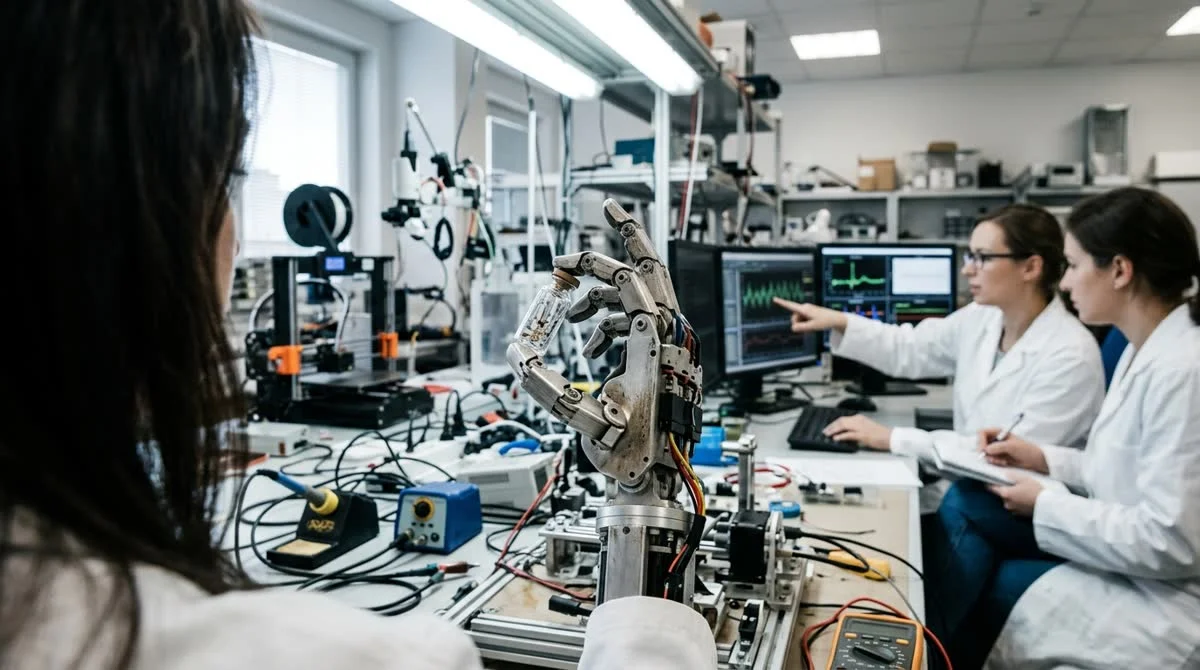
China is concentrating resources on solving the most complex task in modern robotics — creating dexterous robotic hands capable of replicating the capabilities of the human hand. By July 2026, most companies leading this race within the concept of "embodied AI" are based in China.
Why are hands the main barrier in robotics?
The human hand is the most flexible and complex part of the skeleton. Each hand has 27 bones, more than 30 muscles and thousands of nerve endings, which together provide unprecedented precision in control. Tasks that most people perform automatically — tying shoelaces, fastening buttons, picking up a fragile egg without breaking it, turning a wet page — actually require complex multilevel neurological coordination.
Industrial robotic manipulators handle repetitive operations in strictly controlled environments: they weld, move identical parts, tighten bolts on a conveyor belt. But any task requiring adaptation to an unpredictable object or environment proves insurmountable for them. The gap between the best manipulators and the average human hand remains enormous.
What is "embodied AI" and why is it important?
The concept of embodied AI stems from the idea that true intelligence is impossible without physical interaction with the real world. Language models are trained on text and images — but exist in digital space. A robot with dexterous hands, by contrast, learns by acting in a real environment: grasping, moving objects, feeling material resistance.
For humanoid robots, this means a fundamental difference between a "smart screen on legs" and a full-fledged working tool. Today, even the most advanced humanoids are essentially expensive exhibition booths that impress at presentations but fail at tasks a six-year-old child handles without thinking. Dexterous hands are precisely the threshold that separates a robot as a novelty from a robot as a worker.
Why has China pulled ahead?
China's leadership in this race is explained by a combination of factors. Developed manufacturing infrastructure allows for rapid prototyping and scaling of hardware solutions. Large-scale government investments in robotics and AI create a stable financial base for long-term development. Close integration of hardware and software teams accelerates iterations.
Dozens of Chinese startups and large technology companies are actively competing for the lead in creating a commercially viable dexterous hand. The stakes are high: humanoid robotics is one of the most promising sectors of the next decade, and the market, by analysts' estimates, is measured in trillions of dollars. Whoever first solves the dexterous hand problem gains a strategic advantage that will determine the face of industry, logistics and daily life for many years to come.
What does this mean
A dexterous robotic hand is not just an engineering task, but a transition point for the entire humanoid robot industry. Once this problem is solved, robots will be able to work in warehouses, hospitals, production lines and homes without special environmental adaptation. Judging by where the main efforts and resources are concentrated, China intends to be first to cross this threshold.
Need AI working inside your business — not just in your newsfeed?
I build production AI for companies — custom CRM, internal tools, autonomous agents, workflow automation. Owned by you, shaped to your process, no per-seat tax. Built by Zhemal Khamidun, CPO of AlpinaGPT (AI platform, 6,000+ users).
The AI world, distilled — once a week
Seven stories that actually mattered, hand-picked. No noise, no reposts, no press releases.
Done! Check your inbox for a confirmation.