Nvidia Postpones Kyber Server Cabinet to 2028 Due to Single Board
Nvidia is deferring the Kyber server cabinet to 2028 — it was scheduled to launch with Rubin Ultra chips in 2027. The culprit: a single board inside the system blocked the entire manufacturing timeline. Kyber is not a chip but a rack housing 144 accelerators, critical infrastructure for hyperscalers Microsoft, Google, and Amazon.
AI-processed from TNW; edited by Hamidun News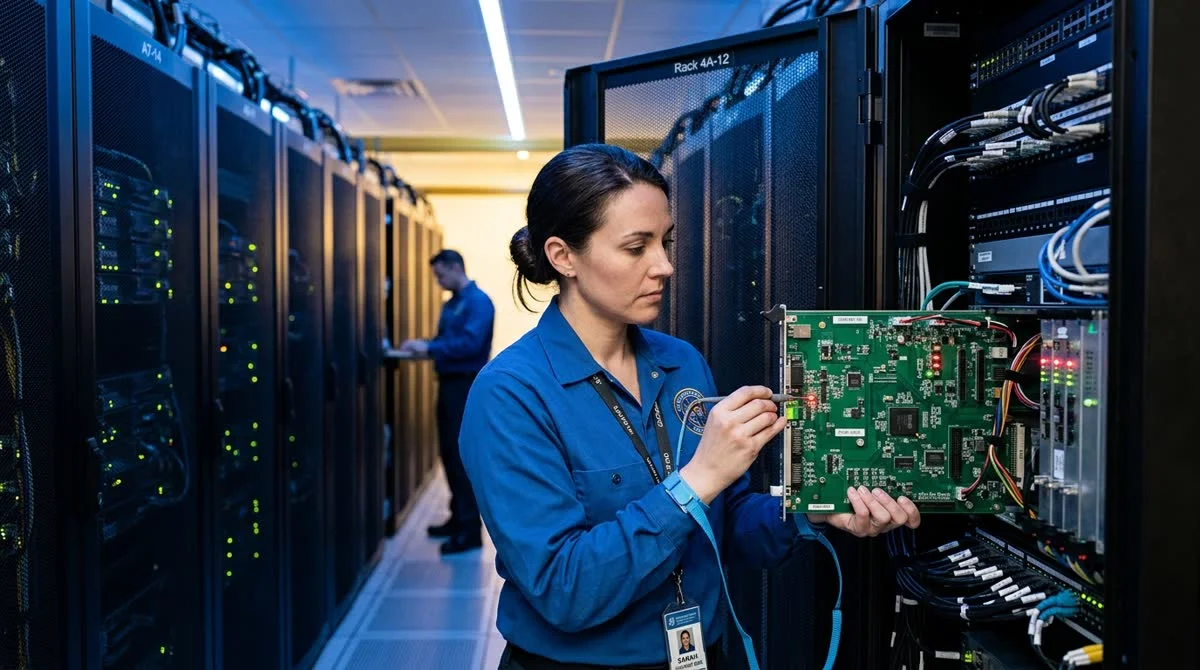
Nvidia has postponed its Kyber server cabinet to 2028 — one of the boards in the system is to blame for the delay. The release of Kyber was originally planned for 2027: the cabinet was supposed to appear simultaneously with next-generation Rubin Ultra chips. The analytical firm SemiAnalysis was the first to report the postponement, followed by CNBC.
What
Kyber is — and why it's more important than a regular GPU
The name Kyber is still relatively unfamiliar to the general public — unlike Blackwell or Rubin Ultra, which Nvidia actively promotes as flagship accelerators. Kyber is not a processor or a GPU. It's a server cabinet: an industrial rack into which 144 Rubin Ultra accelerators are installed, connected by high-speed interconnects.
In terms of scale and significance, such a system is an entirely different class of product. Nvidia's individual GPUs are purchased by thousands of companies of various sizes. The Kyber cabinet is an infrastructure solution primarily for hyperscalers: Microsoft Azure, Google Cloud, Amazon AWS, and Meta, which build data centers from hundreds and thousands of such racks to train the largest AI models. A delay at the cabinet level means that access to next-generation computing infrastructure is postponed for the entire industry at once.
Why one board stopped the entire rack
According to SemiAnalysis, the reason for the timeline shift was a specific board inside the cabinet. The exact type of component, its manufacturer, and the nature of the malfunction have not been publicly disclosed. From publicly available information, it is only known that the problem was localized, but its elimination required enough time to shift the entire production schedule to the right.
Highly complex server systems are particularly vulnerable to such "points of failure." The final product — a cabinet of 144 accelerators — is assembled from thousands of components supplied by multiple manufacturers. One unreliable element can stall the final assembly of an entire batch. Something similar already happened with its predecessor: during the first deliveries of Blackwell racks, some customers encountered overheating problems, which required a redesign.
Replacing a supplier — even when an alternative exists on the market — is also not resolved quickly. Integrating a new component into already agreed-upon production chains requires additional engineering coordination, testing, and validation, which itself takes months.
Key facts:
- The delay was identified and published by the analytical firm SemiAnalysis
- Kyber is designed for 144 Rubin Ultra accelerators
- The timeline has shifted from 2027 to 2028
- The cause was one board — a single component in the rack
What this means
Postponing Kyber by a year is not just unpleasant news for Nvidia shareholders. For the company, this is a strategic risk at a time when competitors are accelerating: AMD is promoting its MI300/MI350 accelerator series, Google, Amazon, and Microsoft are developing their own AI chips — TPU, Trainium, and Maia — and startups like Cerebras and Groq are offering unconventional low-latency architectures.
While Nvidia holds a market share above 80% in the AI accelerator market, systematic supply disruptions could accelerate diversification among major buyers. For hyperscalers planning capital investments several years ahead, predictability of delivery timelines is no less important than the technical specifications of the chips themselves.
*Meta is recognized as an extremist organization and is banned in the Russian Federation.
Need AI working inside your business — not just in your newsfeed?
I build production AI for companies — custom CRM, internal tools, autonomous agents, workflow automation. Owned by you, shaped to your process, no per-seat tax. Built by Zhemal Khamidun, CPO of AlpinaGPT (AI platform, 6,000+ users).
The AI world, distilled — once a week
Seven stories that actually mattered, hand-picked. No noise, no reposts, no press releases.
Done! Check your inbox for a confirmation.