Anthropic Prompts vs grill-me Skill: A Two-Hour Test by a Non-Developer in Claude Code
A Habr user with no development experience spent two hours in Claude Code comparing five ready-made prompts from Anthropic's official library and the grill-me skill. In parallel, wrote a Habr article parser right during the session. Conclusion: prompts work well for one-off tasks, grill-me skill functions as a stable critical mode for the entire session. Analyzed where to apply each by specific use cases.
AI-processed from Habr AI; edited by Hamidun News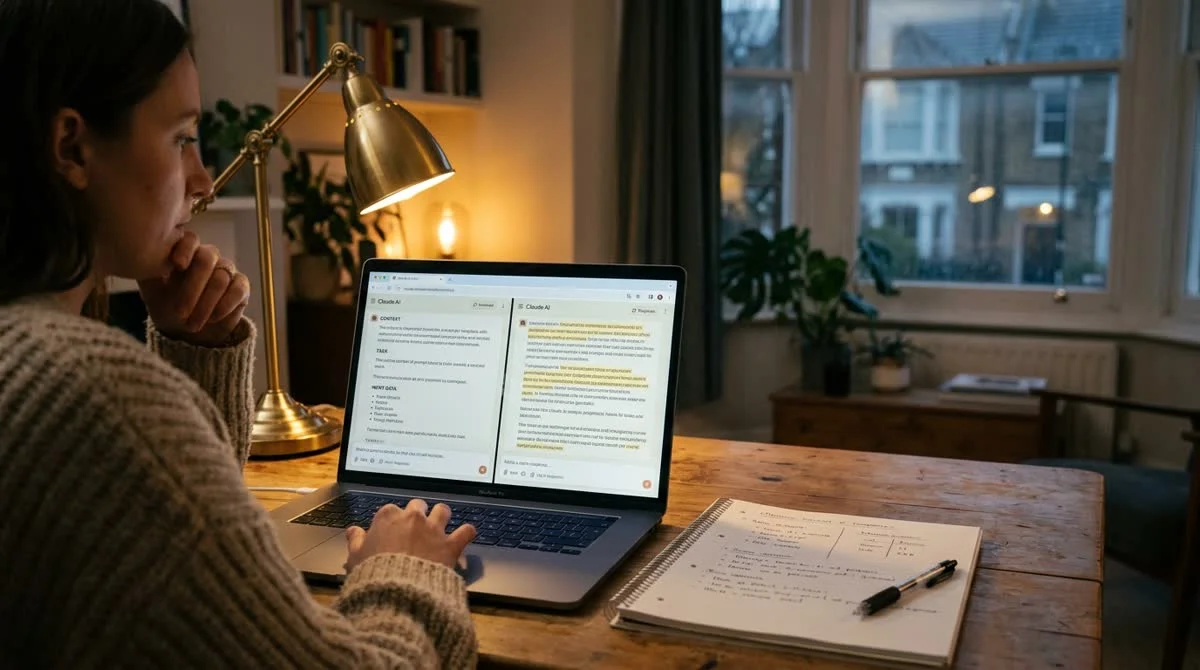
Claude Code for beginners: in July 2026, a Habr user without programming experience conducted a two-hour experiment comparing five ready-made prompts from Anthropic's official library with a built-in skill — and along the way wrote a Habr article parser, coding for the first time in his life.
How prompts differ from skills in Claude Code
Anthropic's prompt library is a public collection of ready-made templates for specific tasks: rewriting texts, analyzing data, generating code, structuring material. Each prompt is inserted at the beginning of a conversation and immediately provides a predictable result without additional configuration.
Skills in Claude Code work fundamentally differently. These are built-in modes of behavior that remain active throughout the entire session: you enable it once — and the model behaves differently until the end of the conversation. The grill-me skill specializes in harsh criticism: counter-questions, pointing out contradictions, analyzing weak points — without compliments and preliminary warm-up.
Key difference: a prompt is a one-time instruction for a single request. A skill is a sustained character of the model for the entire session, no matter how many queries it includes.
What the test of five prompts showed
The author took five prompts from Anthropic's official library and ran real Habr materials through each one. The parser for downloading articles was written directly during the experiment, without any prior development knowledge.
- Five prompts — for rewriting, analysis, stylistic editing, translation, and text structuring
- Habr article parser written during the session without programming experience
- Each prompt tested on the same source materials
- Comparison by parameters: depth, accuracy, context retention between requests
- Total experiment time — about two hours
Prompts from the library proved to be reliable one-time tools: quick start, predictable result, minimal configuration. The main drawback is loss of context between requests. Each new prompt starts the conversation anew, you need to explain the task again. When working on a long project, this quickly becomes tedious.
Where the skill proved stronger
Grill-me changes the conversation dynamic from the first exchange: the model returns counter-questions, points out contradictions, demands justification where a prompt would simply execute the instruction.
"A skill doesn't let you relax.
A prompt is a static tool. A skill is a different interlocutor in the same session".
The main advantage is the session memory of the mode. Once activated grill-me, the author didn't enter instructions with each request: the critical character was preserved throughout all two hours. This is especially important in iterative editing, when a task gradually clarifies during work.
The weak point of the skill: for simple tasks, it's excessive. Reformatting a list or fixing a headline is easier through a prompt — grill-me will ask questions where you need an executor, not a critic. The skill also works more effectively with analytical and editorial texts than with technical instructions.
What this means
There is no universally better tool in Claude Code — there is a tool suited for a specific task. Prompts from Anthropic's library are the optimal choice for isolated one-time operations. Skills like grill-me are for long iterative sessions where it's important to maintain the desired mode of interaction. For people without development experience, it's crucial: both tools are accessible without writing code and produce a noticeable difference already after several requests.
Can you learn Claude without programming experience?
Yes. A Habr user created a working article parser in two hours using ready-made Anthropic prompts and built-in Claude Code tools, despite having no coding experience.
How do prompts and skills differ in Claude Code?
Prompts are ready-made templates from Anthropic's library that are inserted at the beginning of a conversation and immediately provide a predictable result. Skills are more specialized tools that require additional configuration.
Need AI working inside your business — not just in your newsfeed?
I build production AI for companies — custom CRM, internal tools, autonomous agents, workflow automation. Owned by you, shaped to your process, no per-seat tax. Built by Zhemal Khamidun, CPO of AlpinaGPT (AI platform, 6,000+ users).
The AI world, distilled — once a week
Seven stories that actually mattered, hand-picked. No noise, no reposts, no press releases.
Done! Check your inbox for a confirmation.