TeraFab from Tesla: Elon Musk Decided to Outmaneuver Nvidia on Its Own Playing Field
It's time to admit the obvious: Tesla stopped being just a car company long ago. If you still evaluate it by the number of sedans sold, you're missing the most interesting part. Elon Musk has finally settled on the idea that the future of his empire depends not on the quality of vehicle assembly, but on computing power. His new announcement about building TeraFab — his own semiconductor manufacturing facility — is not just another flashy quote for investors. It's a declaration of war against the current order in the chip industry, where all roads lead either to Nvidia or to TSMC. Tesla's relationship with hardware has always been a story of striving for total control. At first, the company used ready-made solutions from Nvidia for its Autopilot, but quickly realized that third-party chips always meant compromise. They were universal, but Musk needed something specific.
AI-processed from Bloomberg Tech; edited by Hamidun News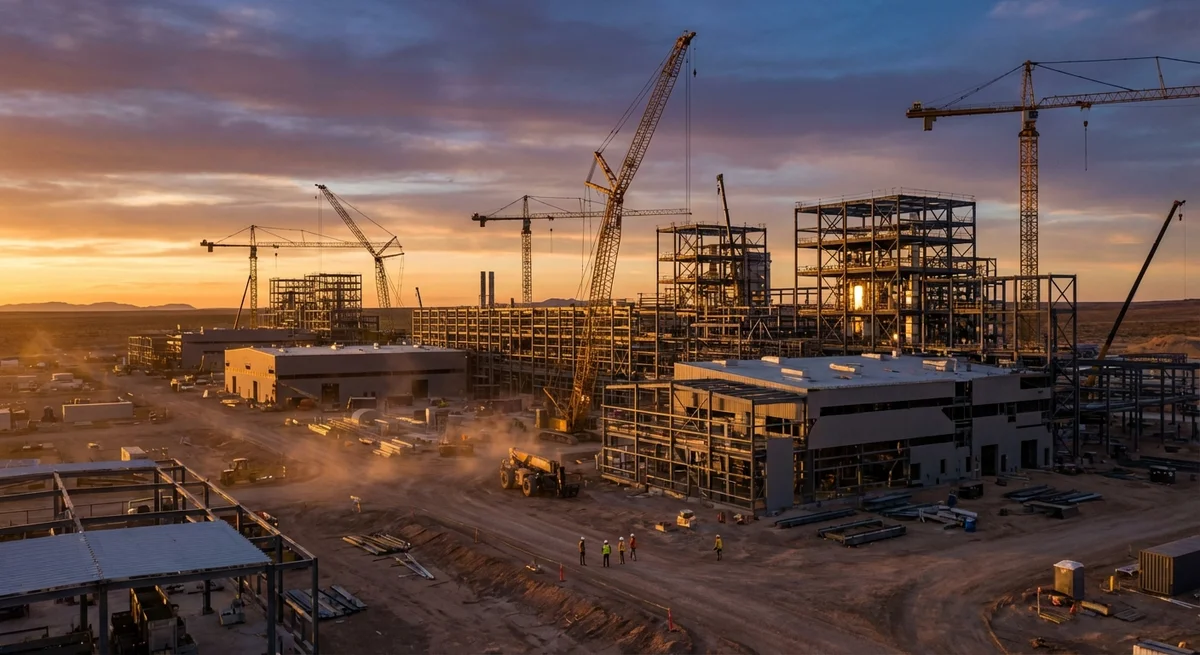
Elon Musk announced that Tesla must build and launch its own semiconductor manufacturing plant — TeraFab. According to Bloomberg Tech, this large-scale enterprise will cost billions of dollars and will become yet another expansion for Tesla beyond its core business — electric vehicle production.
From other companies' chips to its own plant
The history of Tesla's relationship with chip manufacturing is a path toward total control. At first, the company used ready-made Nvidia solutions for Autopilot, but such chips were universal and didn't provide the specificity needed. Then Tesla designed its own FSD chips, outsourcing their production to third-party foundries. Now Musk wants to own not just the blueprints, but the lithography machines themselves. TeraFab is conceived as a vertically integrated production facility, capable of producing silicon in the volumes needed to train Dojo neural networks and power Optimus robots.
Why Tesla wants to ditch TSMC and Nvidia
Musk doesn't want to depend on TSMC's production schedules or Jensen Huang's priorities: the world has already seen how the industry grinds to a halt when chips run short. When a company builds supercomputers to train AI, it is either the customer or the one in control — TeraFab is meant to make Tesla the latter. By Musk's logic, if Tesla becomes the only company capable of mass-producing chips, software, and robots all under one roof, this would sharply boost its market capitalization. The construction is launching against a backdrop of turbulence in the automotive market and growing competition from China.
Chip manufacturing is not car assembly
Semiconductor manufacturing is one of the most complex and capital-intensive industries in the world: Intel has spent years pouring tens of billions of dollars into trying to reclaim its leadership, not always successfully. Mastering nanometer-scale process technology will be a serious challenge for Tesla's engineers and financiers. As Musk envisions it, TeraFab should free the company from dependence on others' manufacturing capacity in AI and autonomous driving — and serve as insurance in case computing power becomes more expensive than oil.
What is TeraFab?
TeraFab is Tesla's planned in-house semiconductor manufacturing plant, whose necessity Elon Musk has announced. Construction will cost billions of dollars and will become yet another expansion for Tesla beyond its core automotive business.
Why is
Tesla moving from third-party chips to its own production?
Tesla previously used ready-made Nvidia chips for Autopilot, then switched to its own FSD chips, which it designed itself but manufactured at third-party foundries. TeraFab is meant to give the company control over the production process itself — including the lithography machines — in order to produce silicon for Dojo neural networks and Optimus robots.
What is Tesla trying to get rid of by ditching TSMC?
Dependence on TSMC's production schedules and Jensen Huang's priorities when obtaining chips for AI training. Musk wants Tesla itself to be "the one in control," rather than a customer of other companies' foundries.
Need AI working inside your business — not just in your newsfeed?
I build production AI for companies — custom CRM, internal tools, autonomous agents, workflow automation. Owned by you, shaped to your process, no per-seat tax. Built by Zhemal Khamidun, CPO of AlpinaGPT (AI platform, 6,000+ users).
The AI world, distilled — once a week
Seven stories that actually mattered, hand-picked. No noise, no reposts, no press releases.
Done! Check your inbox for a confirmation.