Google's Project Genie: Now Anyone Can Build Their Own Mario 64 (But Very Poorly)
Imagine waking up in a world where creating a new installment of a legendary franchise doesn't require hundreds of programmers, five years of development, and a budget rivaling a small nation. All you need is to simply ask your computer. This week, Google DeepMind threw fuel on the fire of these tech fantasies by giving select testers a chance to try Project Genie—its new experimental tool that transforms text into something resembling interactive worlds. One lucky tester immediately decided to stress-test the system and made it generate clones of Nintendo hits. The result came out strange, occasionally terrifying, but incredibly important for understanding where the entire entertainment industry is heading. Let's be honest: what Genie produces right now looks like a bad dream of a nineties gamer.
AI-processed from The Verge; edited by Hamidun News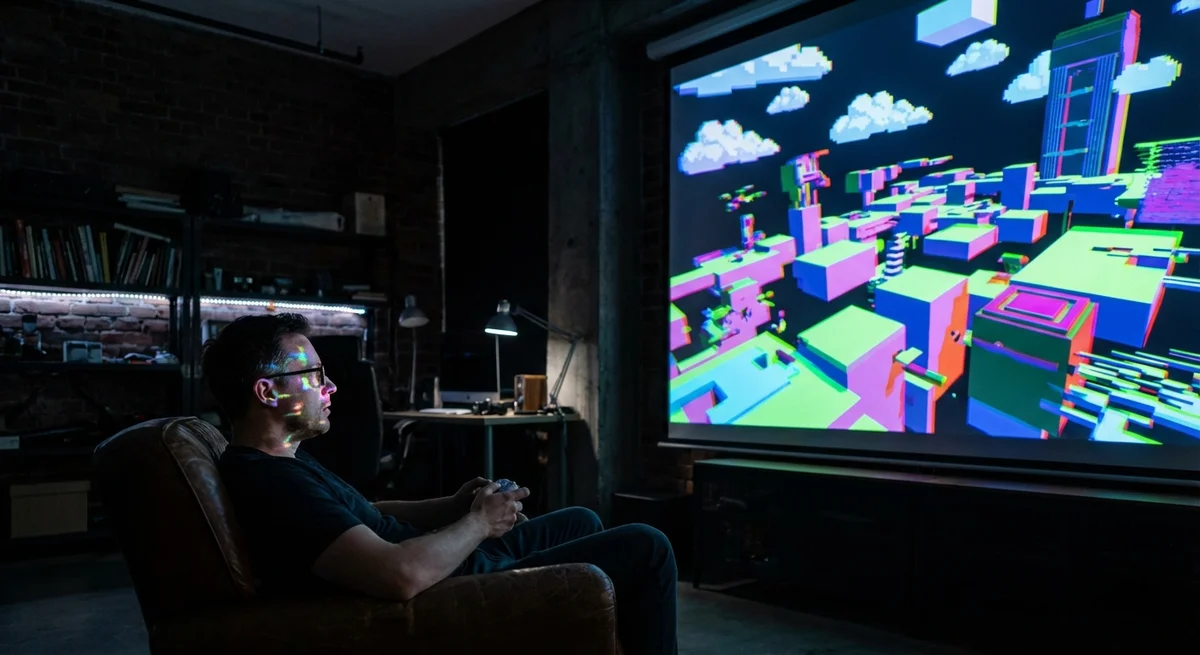
Google DeepMind this week gave selected testers access to Project Genie — an experimental tool that turns a text description into something resembling an interactive 3D world. One of the testers, the author of a piece on The Verge, used the access to generate his own versions of worlds inspired by Super Mario 64, Metroid Prime, and The Legend of Zelda: Breath of the Wild — complete with paragliders and, briefly, two Links on screen at the same time.
What Project Genie is
Genie is an experimental prototype from Google DeepMind that differs from ordinary video generators. A regular video generator simply predicts the next frame; Genie tries to simulate control and the world's response to user actions — meaning it's not just a video stream, but a controllable interactive scene. The model was trained on a large volume of gameplay footage and "picked up" how the rules of virtual worlds work, instead of being directly programmed according to the laws of physics: if a character presses the jump button, the neural network "knows" that the camera should rise and the ground should drop away, simply because "that's usually how it goes" in the footage it has seen.
What the generated worlds look like
When Genie is asked to create something resembling Super Mario 64 or Metroid Prime, it draws three-dimensional landscapes that fall apart the moment you try to interact with them. In one example, two Link characters ran on screen at the same time, and the jump physics resembled an indie horror game. The image is covered in artifacts, objects appear out of nowhere, and the controls feel sluggish, "as if wading through jelly."
What this could mean for game development
Ordinary games are built on manual labor: behind every object in a virtual world lies the work of a modeler, and behind jump physics — thousands of lines of physics-engine code. Project Genie takes a different path — learning from examples instead of rigid programming. If the pace of development of this kind of model follows the path of image generators (from recognizable distortions to the photorealistic images of Midjourney), such a tool could eventually produce not just crude sketches but fully playable levels.
This raises questions about copyright over visual style, if a neural network generates a "not-Mario" from a single text description in real time, as well as about the role of traditional engines like Unreal or Unity: instead of manually configuring lighting and collisions, the model could generate level variations on the fly, right down to content that adapts to a specific player.
What is Project Genie?
Project Genie is an experimental tool from Google DeepMind that turns a text description into something resembling an interactive 3D world; this week selected testers gained access to it.
What exactly did the tester generate with Genie?
His own versions of worlds inspired by Super Mario 64, Metroid Prime, and The Legend of Zelda: Breath of the Wild — including a paraglider and, briefly, two Link characters on screen at the same time.
How does Genie differ from ordinary video generators?
A regular video generator predicts the next frame, while Genie tries to simulate control and the world's response to user actions, learning from gameplay footage rather than from programmed laws of physics.
Need AI working inside your business — not just in your newsfeed?
I build production AI for companies — custom CRM, internal tools, autonomous agents, workflow automation. Owned by you, shaped to your process, no per-seat tax. Built by Zhemal Khamidun, CPO of AlpinaGPT (AI platform, 6,000+ users).
The AI world, distilled — once a week
Seven stories that actually mattered, hand-picked. No noise, no reposts, no press releases.
Done! Check your inbox for a confirmation.