Unmanned Laboratory: China Launches AI System for Autonomous Material Creation
While we debate whether GPT-5 can replace programmers, deep within the Chinese Academy of Sciences (CAS) researchers have quietly completed something far more tangible. They unveiled a multi-agent system for developing new materials—something that once required decades and thousands of human-hours in white coats. This isn't just another algorithm for predicting molecular properties, but a full-fledged digital team capable of controlling real robots in physical laboratories. Science is finally switching to autopilot, and it seems humanity is about to become the slowest link in this chain. Traditional materials science has always resembled a very expensive lottery. Scientists spent years testing combinations of elements, hoping to find that elusive superconductor or catalyst. This was called the "Edisonian approach"—endless trial and error, where each failure cost weeks of lab work.
AI-processed from Jiqizhixin (机器之心); edited by Hamidun News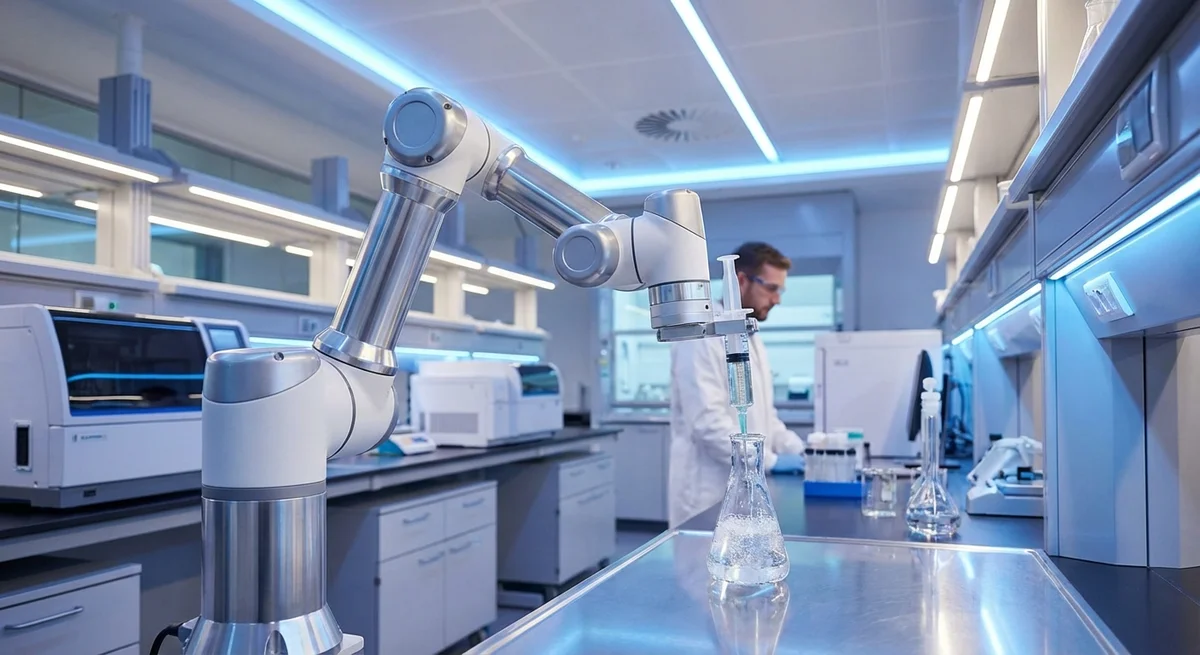
Scientists at the Chinese Academy of Sciences (CAS) have built a multi-agent AI system for developing new materials that closes the entire loop — from formulating a hypothesis to controlling robots in a physical laboratory — without human involvement at intermediate stages. As Jiqizhixin (机器之心) reports, this is a working example of an "autonomous closed loop" in materials science, where the traditional trial-and-error method (the so-called "Edisonian approach") has been replaced by a combination of several specialized language models and robotic manipulators.
Three agents instead of a research department
At the core of the system is a multi-agent architecture that mimics the work of an entire research institute. One agent plays the role of "librarian": it analyzes thousands of scientific papers and extracts data on previous successful and failed experiments. The second agent — the "theorist" — models atomic interactions at the quantum level, predicting the properties of a future material before it is even synthesized.
The third agent, the "engineer," translates abstract chemical formulas into concrete instructions for laboratory equipment — that is, into a protocol a robot can execute. The agents do not work in isolation: they exchange data, debate and correct each other's actions in real time, imitating the work of a full research team rather than separate molecule-property prediction programs.
Closed loop: hypothesis → experiment → analysis → new iteration
When the "engineer" sends a command to the robot, it physically mixes reagents or sinters powders — without a human present at the instrument. If the result does not match the theoretical model's prediction (which, in science, happens almost always), the system does not hit a dead end: it analyzes sensor data, determines at what point theory diverged from practice, and launches the next iteration of the experiment on its own. This is precisely the autonomous closed loop that tech giants have long talked about. The human only needs to set the initial search parameters and watch as a material with the desired properties emerges on screen.
Why this matters: materials R&D has hit a ceiling
Classical materials science spent years sifting through combinations of elements in search of the right superconductor or catalyst — the "Edisonian approach": endless trial and error, where every failed attempt costs weeks of lab work. Industry is now running into a technological ceiling on several fronts at once — from battery capacity to solar panel efficiency — and new materials are needed faster than classical science can deliver. The CAS project demonstrates that pairing LLMs with robotics can shorten the R&D cycle tenfold or even a hundredfold — because the system formulates its own hypothesis, plans its own experiment and runs it itself, while Western startups focus on generating text and images.
What happens to the role of human scientists
A direct consequence of automating routine lab operations is a transformation in the role of graduate students and researchers, whose work used to consist of monotonously mixing reagents and calibrating instruments. That routine now shifts to robots controlled by the multi-agent system, while humans are left to formulate tasks for the AI agents and interpret the results — including those that contradict classical scientific intuition. In effect, scientific discovery in this model becomes a product of efficiently managing neural networks rather than the result of one scientist's chance flash of insight.
What did the CAS researchers unveil?
A multi-agent AI system for developing new materials that operates on the principle of an autonomous closed loop: it formulates its own hypothesis, plans the experiment, and carries it out using robotic manipulators in a physical laboratory — without step-by-step human involvement at every stage.
How are roles divided among the system's agents?
The system is built like a virtual research institute made up of three specialized agents: the "librarian" analyzes scientific papers and data from past experiments, the "theorist" models atomic interactions at the quantum level, and the "engineer" translates chemical formulas into instructions for laboratory robots. The agents exchange data and correct each other's actions in real time, imitating the work of a research team.
What happens if the experimental result doesn't confirm the theory?
The system analyzes sensor data from the laboratory equipment, determines at what point the theoretical model diverged from the practical result, and automatically launches the next iteration of the experiment — without pausing for human analysis. This is precisely what makes the loop "closed": the hypothesis, experiment and correction all happen without ever leaving the autonomous loop.
Need AI working inside your business — not just in your newsfeed?
I build production AI for companies — custom CRM, internal tools, autonomous agents, workflow automation. Owned by you, shaped to your process, no per-seat tax. Built by Zhemal Khamidun, CPO of AlpinaGPT (AI platform, 6,000+ users).
The AI world, distilled — once a week
Seven stories that actually mattered, hand-picked. No noise, no reposts, no press releases.
Done! Check your inbox for a confirmation.