How MCP servers are turning IDEs into smart developer assistants
A developer ran into a typical problem: language models generate attractive but already taken domain names. Instead of manually checking each option, the developer connected a custom MCP server with WHOIS queries to Cursor IDE. Now the AI agent suggests domains on its own and instantly checks their availability. The case clearly shows how the MCP protocol is changing the approach to AI assistants: the model stops being self-contained and gains access to real external services directly from the development environment.
AI-processed from Habr AI; edited by Hamidun News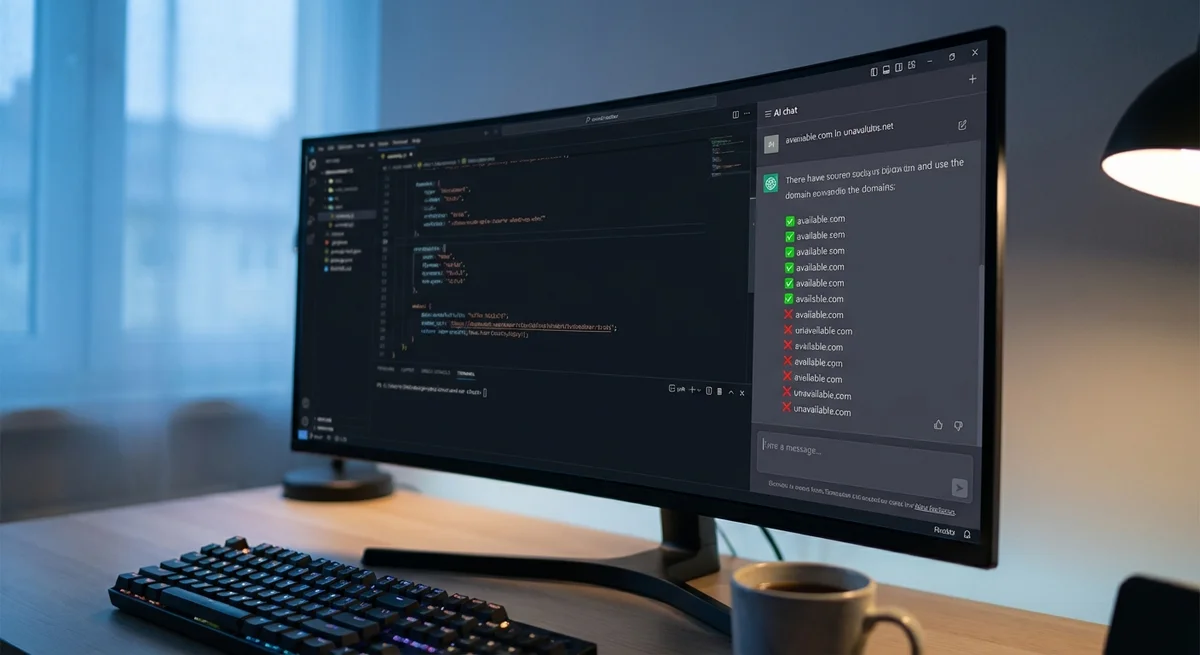
# MCP server solves the age-old problem of AI domain name generation: the agent checks WHOIS itself in 5 minutes of setup
A developer from Habr connected Cursor IDE to his own MCP server for WHOIS checking — now the AI agent doesn't just suggest domain names, it immediately filters out taken ones and shows only available options. According to the author, the entire setup takes about five minutes.
The problem: LLMs can't see WHOIS in real time
Anyone who has ever asked ChatGPT or Claude to come up with a domain name knows this vicious cycle: the model produces a dozen brilliant options, you open a registrar — and they're all taken. The reason lies in the very nature of language models: they work with a frozen snapshot of data and can't query a WHOIS server on the spot to check whether a name is available. Checking every option manually is an activity capable of killing any enthusiasm.
The story started by chance: the author had recently launched a joke service that unexpectedly picked up traffic, and decided to go after the global market. While searching for a .com domain, he ran into this classic pain point — LLMs generate beautiful but already-taken options.
The solution: a custom MCP server and Cursor
The developer wrote his own MCP server that accepts a domain name and returns the result of a WHOIS query, then connected it to Cursor — a popular IDE with a built-in AI assistant. The Model Context Protocol (MCP) is an open standard proposed by Anthropic that lets language models interact with external tools and data sources through a unified interface. Previously this required writing complex function-calling integrations; now it's enough to plug in a ready-made "plugin."
The result: the agent inside Cursor comes up with a domain for the project, immediately queries the MCP server, checks the availability of each name via WHOIS, and returns only the available options — the entire cycle happens in a single window, with no context switching. According to the author, setup takes about five minutes: you just need to add the MCP server configuration in Cursor's settings.
MCP as a new infrastructure layer for AI agents
The significance of this case goes beyond domain checking. Before MCP, an AI assistant in an IDE was, in essence, a very smart autocomplete: it generated code, explained it, and refactored it, but remained locked inside its own linguistic competence. Now the model is becoming an orchestrator — it doesn't just think, it acts, reaching out to external APIs, databases, file systems, and other services.
The MCP server ecosystem is growing rapidly: ready-made servers already exist for GitHub, Slack, databases, file storage, browsers, and dozens of other tools. Cursor, Claude Desktop, and a number of other clients support the protocol natively. A new infrastructure layer is forming — a kind of "app store" for language models, where each MCP server extends the agent's capabilities with a specific skill.
Limitations: local hosting and open security questions
MCP servers currently require local execution or self-hosting, security questions around granting a model access to external services remain open, and the standard itself continues to evolve. Nevertheless, the direction is clearly set: the future of AI assistants lies not in isolated text generation, but in the ability to act in the real world through tools — and a small MCP server for domain checking is a vivid illustration of this shift.
What is the Model Context Protocol (MCP)?
MCP is an open standard proposed by Anthropic that lets language models interact with external tools and data sources through a unified interface. It replaces complex function-calling integrations with a ready-made "plugin" — an MCP server — that gives the model access to a specific skill, whether it's WHOIS checking, working with GitHub, Slack, databases, or file storage.
Why can't AI check on its own whether a domain is available?
A language model works with a frozen snapshot of training data and has no direct access to external sources in real time, so it can't independently query a WHOIS server to find out whether a domain name is taken. That's exactly why LLMs generate beautiful but often already-taken name options — without an external tool like an MCP server, it's physically unable to check this.
How long does it take to set up an MCP server for domain checking in
Cursor?
According to the solution's author, setup takes about five minutes: you just need to add the MCP server configuration in Cursor's settings, after which the agent generates domain options itself and immediately checks their availability via WHOIS, returning only the available names.
Need AI working inside your business — not just in your newsfeed?
I build production AI for companies — custom CRM, internal tools, autonomous agents, workflow automation. Owned by you, shaped to your process, no per-seat tax. Built by Zhemal Khamidun, CPO of AlpinaGPT (AI platform, 6,000+ users).
The AI world, distilled — once a week
Seven stories that actually mattered, hand-picked. No noise, no reposts, no press releases.
Done! Check your inbox for a confirmation.