Developer built a spine MRI analyzer with Python and Gemini
A Russian developer built Spine Advisor in a week — a desktop application in Python that uses the multimodal model Gemini 3 Flash to analyze spine MRI scans. The application helps patients clearly track the progress of back treatment through a digital diary. The project grew out of personal experience: the programmer got tired of lower back pain after years of sedentary work and decided to automate what a doctor usually does during an appointment. The case illustrates the growing trend of medical AI tools created by patients themselves.
AI-processed from Habr AI; edited by Hamidun News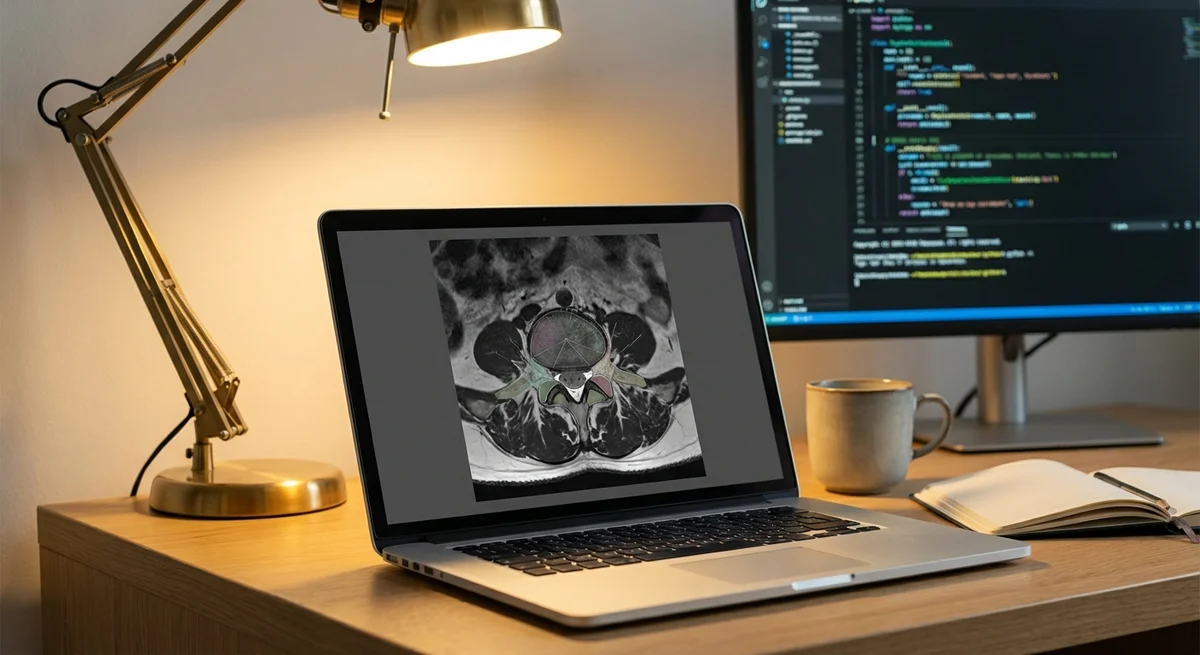
Ten hours a day at the monitor, chronic lower back pain, and yet another neurology appointment—a familiar story for hundreds of thousands of developers around the world. But one of them decided not just to endure it, but to write his own tool for analyzing MRI images of the spine. Thus, Spine Advisor was born—a desktop application written in Python that decodes medical images in seconds using the multimodal Gemini 3 Flash model.
The project story, published on Habr, begins banally and recognizably. The author is a practicing programmer who has ignored his body's signals for years. When occasional "shooting pains" turned into constant discomfort, visits to the doctor became regular, and along with them, a pile of MRI images accumulated. Each time the specialist spent time comparing results, explaining the dynamics, and interpreting conclusions. The developer posed a logical question: could at least part of this routine be offloaded to a language model?
It turned out that it could be. Spine Advisor works like a digital spine diary with a built-in AI assistant. A user uploads MRI images, and the multimodal Gemini 3 Flash model analyzes the images, highlighting key patterns—protrusions, hernias, changes in intervertebral discs. The application allows comparing results over time, tracking treatment progress from visit to visit. Essentially, it's a personal medical tracker that speaks in a language understandable to the patient, rather than leaving him alone with the impenetrable terminology of radiological reports.
The author's technical choice deserves special attention. Gemini 3 Flash is a relatively new multimodal model from Google that performs well at analyzing images while maintaining high speed and reasonable API costs. For a desktop application targeted at ordinary users, this is a reasonable compromise between interpretation quality and cost. The choice of Python as the primary language is also not coincidental: a rich ecosystem of libraries for working with medical images, from pydicom to nibabel, makes it the de facto standard in medical ML.
However, the project raises questions that extend far beyond a single application. We are witnessing the formation of a new class of medical tools—created not by corporations with multimillion-dollar certification budgets, but by patients themselves to solve their own problems. This is both inspiring and alarming. On the one hand, multimodal models have truly reached a level where they are capable of extracting meaningful information from medical images. Research from the past two years shows that large language models on a number of radiological tasks approach the accuracy of intern physicians. On the other hand, none of these models is a certified medical device, and their interpretations should not replace professional diagnosis.
To his credit, the author positions Spine Advisor precisely as an auxiliary tool, not a replacement for a doctor. The application helps the patient prepare for a visit, formulate questions, and track changes—but the final word remains with the specialist. This is an important caveat that medical AI enthusiasts often forget. Regulators around the world, from the FDA to Roszdravnadzor, have not yet developed a unified approach to such "patient" tools, and the legal status of similar applications remains in a gray area.
Nevertheless, the trend is clear. As multimodal models become cheaper and more accessible, and APIs from major providers simplify integration, the barrier to entry for creating medical AI assistants is dropping rapidly. Today one developer assembles an MRI analyzer in a week. Tomorrow, similar tools could become a standard addition to electronic medical records. The question is only whether regulatory frameworks will keep pace with the technology—or whether patients armed with Python and API keys will again find themselves a step ahead of the healthcare system.
Need AI working inside your business — not just in your newsfeed?
I build production AI for companies — custom CRM, internal tools, autonomous agents, workflow automation. Owned by you, shaped to your process, no per-seat tax. Built by Zhemal Khamidun, CPO of AlpinaGPT (AI platform, 6,000+ users).
The AI world, distilled — once a week
Seven stories that actually mattered, hand-picked. No noise, no reposts, no press releases.
Done! Check your inbox for a confirmation.