Former Apple Vision Pro developers created an AI gadget that only activates on button press
Two former Apple Vision Pro developers unveiled an AI wearable that looks like an old iPod Shuffle. It does not listen in the background — only after a button press. The creators are deliberately building around that: privacy as the main argument where Humane AI Pin and Rabbit R1 have already lost users' trust.
AI-processed from Wired; edited by Hamidun News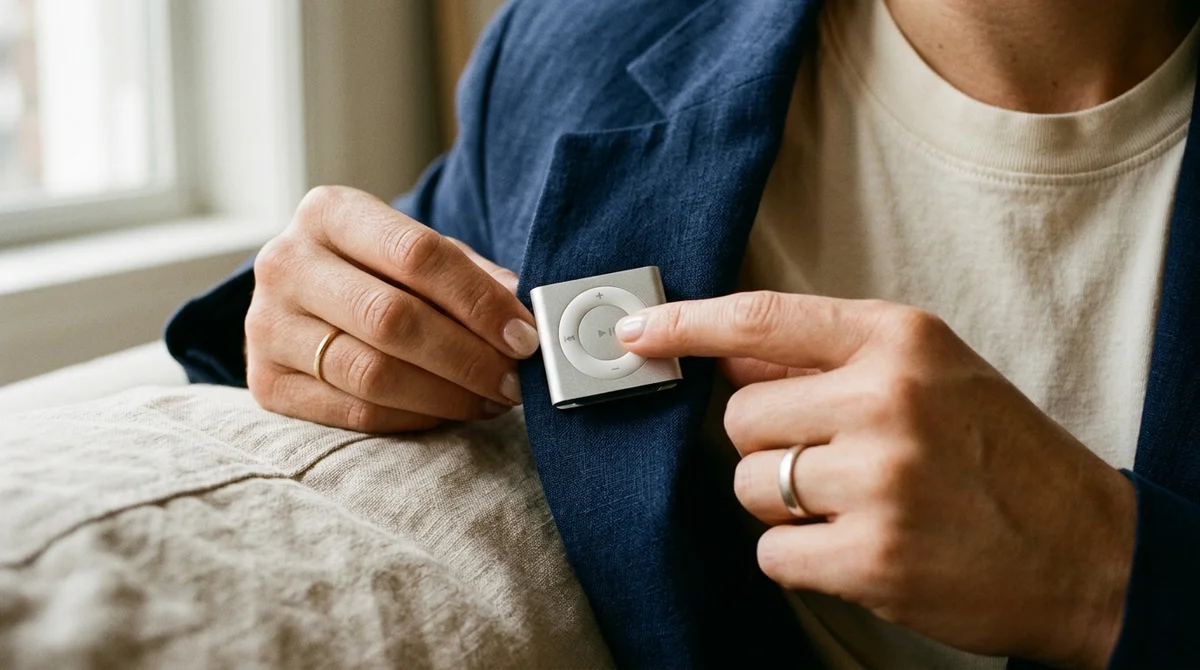
Two former Apple Vision Pro developers created a wearable AI gadget that activates only with physical button press — and intentionally stays silent the rest of the time. In form, it resembles an iPod Shuffle: small, light, clips to clothing, and requires no screen. The device emerged against a backdrop of deep market disappointment in AI wearables.
Humane AI Pin — a startup backed by OpenAI and star-studded investors — failed so catastrophically that the company had to be sold to HP for 116 million dollars. Users complained about overheating, poor recognition, and practical uselessness. Rabbit R1 promised a revolution in app control through AI, but turned out to be an overhyped gadget with raw software and disappointing real-world application.
AI wearables have yet to find their audience — and the main reason users cite isn't interface or battery, but privacy anxiety. This is exactly what the creators of the new device are betting on. Unlike competitors, their gadget doesn't listen to the surroundings constantly.
No wake word, no background monitoring, no sensation of an open microphone. For AI to turn on, you must physically press a button — like an old tape recorder or walkie-talkie. This isn't a technical limitation but a deliberate design choice.
Both founders worked on Apple Vision Pro — a project Apple positioned as the future of computing. Experience creating a device literally worn on the face and deeply integrated into daily life gave them practical understanding of the limits of acceptable technological intrusion into personal space. A gadget that constantly listens is a fundamentally different psychological reality compared to a phone in your pocket.
Vision Pro exposed this. The new device is built on the opposite principle. Form factor here is no accident.
iPod Shuffle was iconic precisely because it disappeared: didn't occupy your hands, required no screen, simply hung on a jacket. The new AI gadget tries to occupy a similar niche — a device that exists when needed and doesn't exist when not needed. A direct counterpoint to smart speakers and voice assistants that are always on alert.
Details of functionality, price, and release date remain undisclosed. But the very moment of market entry is telling: AI wearables are experiencing a crisis of trust, and the only way to overcome it is not to improve the interface but to rethink the very model of relations between device and user. Push-to-talk is a step backward in terms of the seamlessness that AI promises.
But it's a step forward in terms of control. And judging by the market reaction to the previous generation of gadgets, control matters more than convenience right now.
Need AI working inside your business — not just in your newsfeed?
I build production AI for companies — custom CRM, internal tools, autonomous agents, workflow automation. Owned by you, shaped to your process, no per-seat tax. Built by Zhemal Khamidun, CPO of AlpinaGPT (AI platform, 6,000+ users).
The AI world, distilled — once a week
Seven stories that actually mattered, hand-picked. No noise, no reposts, no press releases.
Done! Check your inbox for a confirmation.