Trump presents plan to limit AI regulation at state level
The White House unveiled a seven-point AI regulation plan. Federal government should avoid most restrictions on the industry—except child protection. States may be forbidden from adopting their own AI laws if they contradict the "national strategy of global dominance."
AI-processed from The Verge; edited by Hamidun News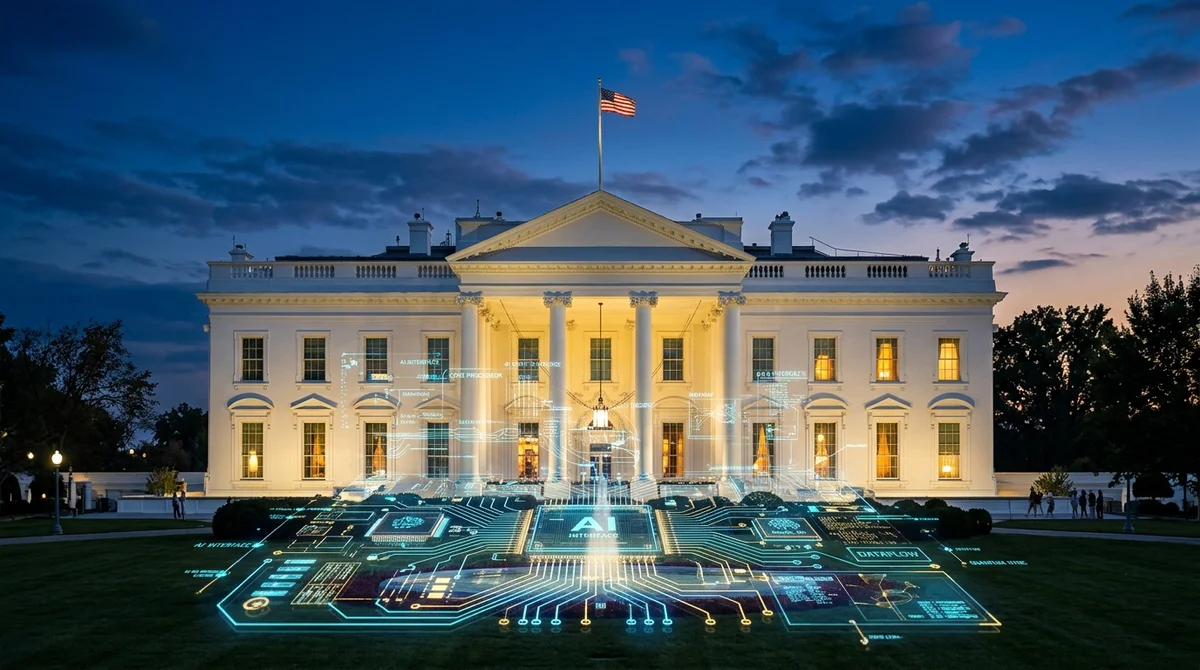
Trump administration presented a plan to restrict AI regulation at the state level
The Trump administration on March 20, 2026 presented a new legislative plan for regulating artificial intelligence: a seven-point document proposes that the federal government abandon most restrictions on AI, except for child protection rules, and prohibit states from interfering with the "national strategy to achieve global dominance in AI."
What the seven-point plan proposes
The plan, published on the White House website, consists of seven points and sends a clear signal: the federal government should avoid most AI regulation beyond a set of child safety rules. The document also requires not allowing individual states to interfere with the implementation of a unified federal strategy in the field of AI — this is not the first attempt by the administration to limit the rights of states to introduce their own AI regulations.
- The plan was published by the Trump administration on March 20, 2026
- The document consists of seven points of legislative recommendations
- The only area where the plan directly recommends new regulation is child protection when using AI services
- The plan urges Congress not to allow a sharp increase in electricity prices due to growth of AI infrastructure
- Separately, the plan encourages "youth development and skills training" to increase familiarity with AI tools
How the plan protects children and the energy system
The plan advises Congress to protect minors using AI services with additional security measures — this is the only area where the document explicitly recommends introducing new rules, leaving all other AI regulation outside the federal agenda. In addition, the plan urges taking measures against sharp increases in electricity costs caused by the expansion of AI infrastructure at data centers — this problem directly affects the country's energy system, not just AI companies themselves.
"National strategy to achieve global dominance in AI" — phrasing from the
White House legislative plan, explaining why states should not interfere in federal AI regulation.
As a separate point, the plan encourages "youth development and skills training" to increase familiarity with AI tools, although without specifics on implementation mechanisms — the document is limited to general formulations, not revealing either funding or specific programs.
What Congress should do next
The plan represents legislative recommendations rather than a ready-made law — the document is addressed to Congress and requires lawmakers to actually turn the proposed seven points into real regulations. This distinguishes the initiative from a presidential executive order: without Congressional action, recommendations on child protection, limiting electricity price increases, and prohibiting states from interfering with the federal AI strategy will remain just a blueprint on paper. The very fact that this is already the second attempt by the administration to limit AI regulation at the state level suggests that the White House considers this issue a priority part of its technology policy.
What this means
The plan consolidates the Trump administration's course toward minimal federal AI regulation and a clear attempt to prevent individual states from introducing their own restrictions: instead of fragmented regulations by state, the bet is made on a unified federal strategy, whose priority is competing with other countries for leadership in AI rather than protecting users beyond child safety and energy system stability.
Need AI working inside your business — not just in your newsfeed?
I build production AI for companies — custom CRM, internal tools, autonomous agents, workflow automation. Owned by you, shaped to your process, no per-seat tax. Built by Zhemal Khamidun, CPO of AlpinaGPT (AI platform, 6,000+ users).
The AI world, distilled — once a week
Seven stories that actually mattered, hand-picked. No noise, no reposts, no press releases.
Done! Check your inbox for a confirmation.