Free ChatGPT for doctors: OpenAI transforms medical automation market
OpenAI announced free access to ChatGPT for Clinicians for certified physicians, nurse practitioners, and pharmacists in the US. The move marks an aggressive expansion into the conservative healthcare sector. The tool aims to handle routine documentation, patient history analysis, and clinical research support. By offering the specialized product for free, OpenAI is not only helping clinicians tackle burnout but dealing a serious blow to dozens of startups that have spent years building paid medical transcription services. For the market, this signals an accelerated shift toward mainstream practice where artificial intelligence becomes as standard a physician tool as the stethoscope.
AI-processed from OpenAI Blog; edited by Hamidun News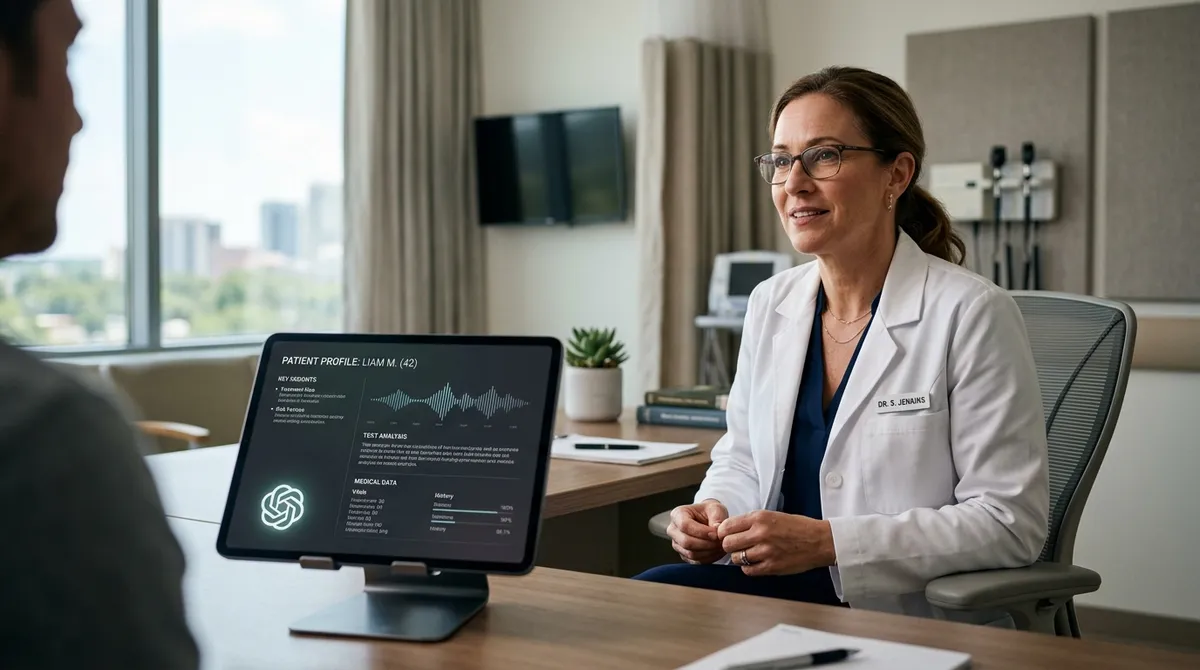
A modern doctor's visit increasingly resembles a session with a database operator: the specialist spends most of the time not looking at the patient, but at a screen, frantically filling out electronic medical records. This routine has become the primary driver of professional burnout in medicine. Now OpenAI has decided to radically change the rules of the game, announcing free access to a specialized version of ChatGPT for Clinicians for all certified physicians, practicing nurses, and pharmacists across the United States. This move goes far beyond simple charity and represents an aggressive strategy to capture one of the world's most conservative and profitable industries.
The problem of administrative burden in healthcare has been building for decades. According to statistics, for every hour of direct patient communication, the average American physician spends up to two hours on paperwork, negotiating prescriptions with insurance companies, and analyzing previous discharge summaries. The medical system has turned highly qualified specialists into expensive bureaucrats. By opening free access to its artificial intelligence, OpenAI offers an immediate solution to this problem. The system can analyze complex medical histories, automatically generate detailed clinical reports based on audio recordings of appointments, and deliver summaries of cutting-edge medical research directly during decision-making.
The decision to make such a powerful tool free reveals the company's ambitious scale. Rather than fighting through endless bureaucratic cycles of corporate procurement, attempting to sell their product to clinic management and hospital networks, OpenAI goes directly to the end user. When hundreds of thousands of physicians begin using ChatGPT daily to optimize their work, clinics will need to adapt their internal security protocols and IT infrastructure to the standards set by OpenAI. This is a classic penetration strategy that forms an irresistible habit and creates a colossal network effect within a closed professional community.
The consequences of this move for the technology market will be seismic. In recent years, an entire ecosystem of startups has grown up around the medical documentation problem, valued at billions of dollars, offering intelligent transcription services and diagnostic assistance through expensive paid subscriptions. Now, as a technology giant rolls out a free alternative of the highest quality, many highly specialized companies will have to fight desperately for survival. They will need to prove their value through deep hardware integration with legacy hospital database interfaces or through niche diagnostic features that OpenAI's base model doesn't yet cover due to legal restrictions.
From a technical standpoint, launching such a product requires an unprecedented level of reliability. Artificial intelligence in medicine cannot afford to hallucinate or make logical errors when it comes to drug dosages or medication compatibility. OpenAI's willingness to open this tool for widespread clinical practice testifies to significant breakthroughs in model architecture, ensuring strict adherence to medical protocols and rigorous compliance with patient privacy protection requirements. The system is clearly designed to operate as a second pilot, where final decision and responsibility always remain with the human specialist, which shields developers from direct lawsuits.
Ultimately, the introduction of free medical ChatGPT returns to healthcare its most important and long-lost value—genuine human contact. By freeing physicians from keyboard servitude, technology allows them to refocus on the person, their actual physical symptoms and nonverbal signals, which machines cannot yet perceive. We are witnessing a turning point where generative artificial intelligence ceases to be an experimental technology and becomes a fundamental part of critical infrastructure, laying the groundwork for an era of truly empathetic medicine.
Need AI working inside your business — not just in your newsfeed?
I build production AI for companies — custom CRM, internal tools, autonomous agents, workflow automation. Owned by you, shaped to your process, no per-seat tax. Built by Zhemal Khamidun, CPO of AlpinaGPT (AI platform, 6,000+ users).
The AI world, distilled — once a week
Seven stories that actually mattered, hand-picked. No noise, no reposts, no press releases.
Done! Check your inbox for a confirmation.