OpenMOSS releases MOSS-Audio — an open audio model that outperforms larger alternatives
OpenMOSS released MOSS-Audio — an open model for understanding speech, music, and ambient sounds in a single stack. The release includes four versions at 4B and 8B parameters, and the flagship 8B-Thinking model, according to the team, outperformed all tested open-source models on standard audio benchmarks, including substantially larger systems. The model is also noted for precise timestamp handling and multi-step audio analysis.
AI-processed from MarkTechPost; edited by Hamidun News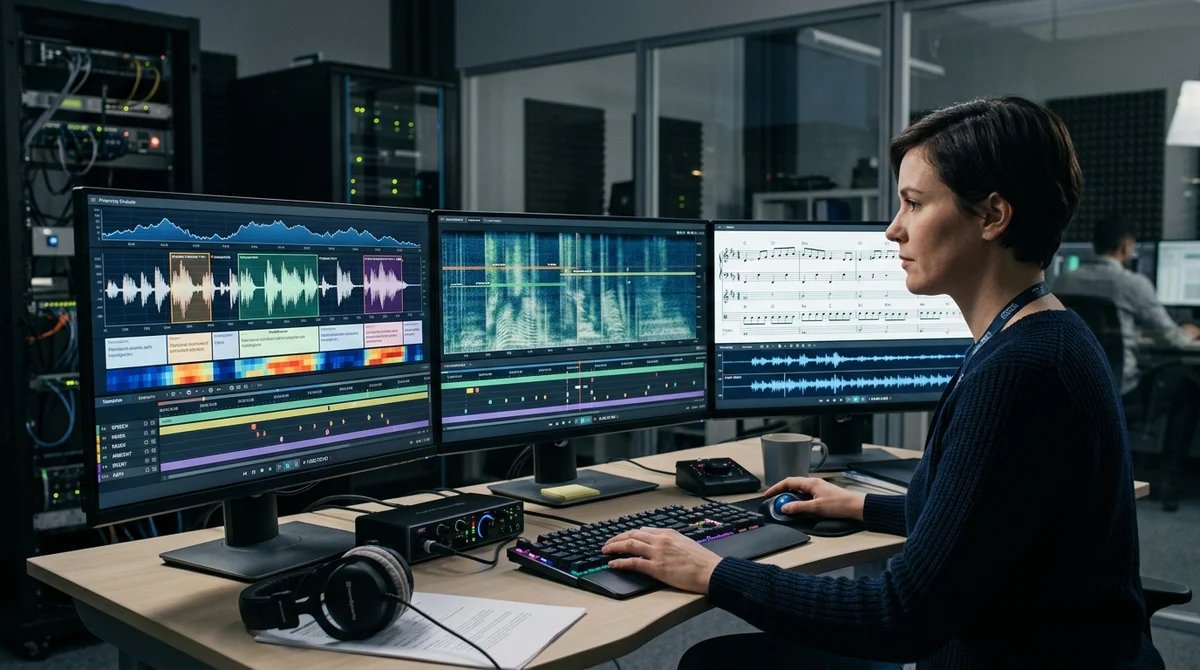
OpenMOSS released MOSS-Audio, an open audio model that outperforms larger alternatives.
OpenMOSS has released a new open-source audio foundation model called MOSS-Audio. This model is capable of solving multiple audio understanding tasks using a single unified architecture. Currently, most audio understanding is handled by separate narrow-purpose models: one for speech recognition, another for emotion analysis, a third for background noise detection, and so on. MOSS-Audio takes a different approach — it combines all these capabilities into one foundation model.
What MOSS-Audio Can Do
MOSS-Audio handles a wide range of audio tasks:
- Speech recognition — converting audio to text
- Emotion analysis — detecting speaker emotion
- Background noise and sound detection — identifying acoustic elements
- Music analysis — understanding musical style, instruments, and characteristics
- Timestamp-based question answering — answering queries about specific moments in audio
Model Architecture
The architecture consists of three main components:
1. Audio encoder — transforms raw audio into compact representations 2. Modality adapter — bridges the audio representation space and the language model 3. Language model — processes the adapted representations and generates responses
Technical
Innovation: DeepStack Cross-Layer Feature Injection
One key innovation is DeepStack Cross-Layer Feature Injection. Instead of feeding audio representations only at the input layer of the language model, intermediate features from the audio encoder are injected directly into early layers of the language model. This allows the model to process audio information more effectively and generate more accurate responses.
Time-Aware Representation
A critical feature is the time-aware representation with explicit temporal tokens. Audio is fundamentally temporal, and MOSS-Audio captures this by:
- Using explicit temporal tokens in the representation
- Maintaining speech recognition with word-level and phrase-level time alignment
- Generating timestamp-based answers with temporal awareness
- Analyzing temporal patterns in music
Temporal representations are computed at 12.5 Hz frequency, providing fine-grained temporal information while remaining computationally efficient.
Benchmark Results
Benchmark evaluations show competitive performance:
- ASR (Automatic Speech Recognition) with CER (Character Error Rate) comparable to specialized models
- AAS (Audio Alignment Score) for timestamp accuracy
- Strong performance on emotion detection and music analysis tasks
Open-Source, Unified Models
The release of MOSS-Audio reflects a broader trend in open-source AI development: the shift from multiple narrow-purpose models to universal foundation models. This approach is more efficient, easier to maintain, and often delivers better overall performance than specialized models, especially when tasks are related or require cross-task reasoning.
Need AI working inside your business — not just in your newsfeed?
I build production AI for companies — custom CRM, internal tools, autonomous agents, workflow automation. Owned by you, shaped to your process, no per-seat tax. Built by Zhemal Khamidun, CPO of AlpinaGPT (AI platform, 6,000+ users).
The AI world, distilled — once a week
Seven stories that actually mattered, hand-picked. No noise, no reposts, no press releases.
Done! Check your inbox for a confirmation.