Apple ML Research
AI news source. Articles are auto-selected and adapted by Hamidun News editors.
Latest publications

Apple ML Research presented a method for generating video with sound from text using Text-to-Sounding-Video
Apple ML Research demonstrated the Text-to-Sounding-Video direction — generating video with sound from text — and identified two key unresolved problems.

Apple ML Research proposed compact models for correcting speech recognition errors
Apple ML Research researchers proposed compact seq2seq models instead of LLMs for correcting ASR errors, training them on real and synthetic errors.

Apple ML Research Presented TopoPrimer—Topological Context for Forecasting Models
Apple ML Research showed TopoPrimer framework, which adds global topological structure of data to time series forecasting models.

Apple identified when on-policy distillation helps model training
Apple ML researchers identified the conditions under which on-policy distillation is effective for training reasoning models, and when it may be ineffective or even counterproductive.

Self-Reflective Program Search: Apple improved LLM performance with long contexts
Apple ML Research published a study on the Self-Reflective Program Search method, which improves how language models handle long contexts through recursive decomposition into subqueries.

Apple developed TGPO to train video models to understand time
Apple ML Research introduced TGPO, a method that teaches video models to understand the order and evolution of events in egocentric video through reinforcement of temporal reasoning.

Apple ML Research: One neuron bypasses safety alignment in LLMs from 1.7 to 70 billion parameters
Apple researchers showed that LLM safety protection can be completely bypassed by targeting a single neuron—without fine-tuning or prompt modification—across seven models from two model families.

Apple Introduces FlowEval: Evaluating AI Interfaces Through Real Navigation Scenarios
Apple ML Research developed FlowEval — a framework for automatic evaluation of AI-generated interfaces based on comparing navigation trajectories with real websites.

Apple ML Research Presents Weblica — A Scalable Environment for Training Visual Web Agents
Apple released the Weblica framework, which reproduces interactive web page states and generates training environments via LLM — to reliably train AI agents operating in browsers.

Apple Developed MT-EditFlow for Multi-Step AI Image Editing
Apple ML Research researchers presented MT-EditFlow — a reinforcement learning-based system that solves the error accumulation problem in iterative image editing.

Apple Research: LensVLM Teaches VLM Models to Read Text in Heavily Compressed Images
Apple ML Research proposed LensVLM — a framework that enables vision-language models to read small text in compressed images without loss of accuracy.

Apple ML Research develops DynaMiCS for fine-tuning LLMs without losing base knowledge
DynaMiCS from Apple formulates data selection during fine-tuning as a constrained optimization problem — to preserve instructions, knowledge, and model safety when adapting to new domains.

Apple ML Research Reveals Inefficiency in Mixture-of-Experts Routing
Apple researchers found that tokens in MoE architectures utilize a negligible fraction of theoretically possible routes, and proposed an architecture to fix this.
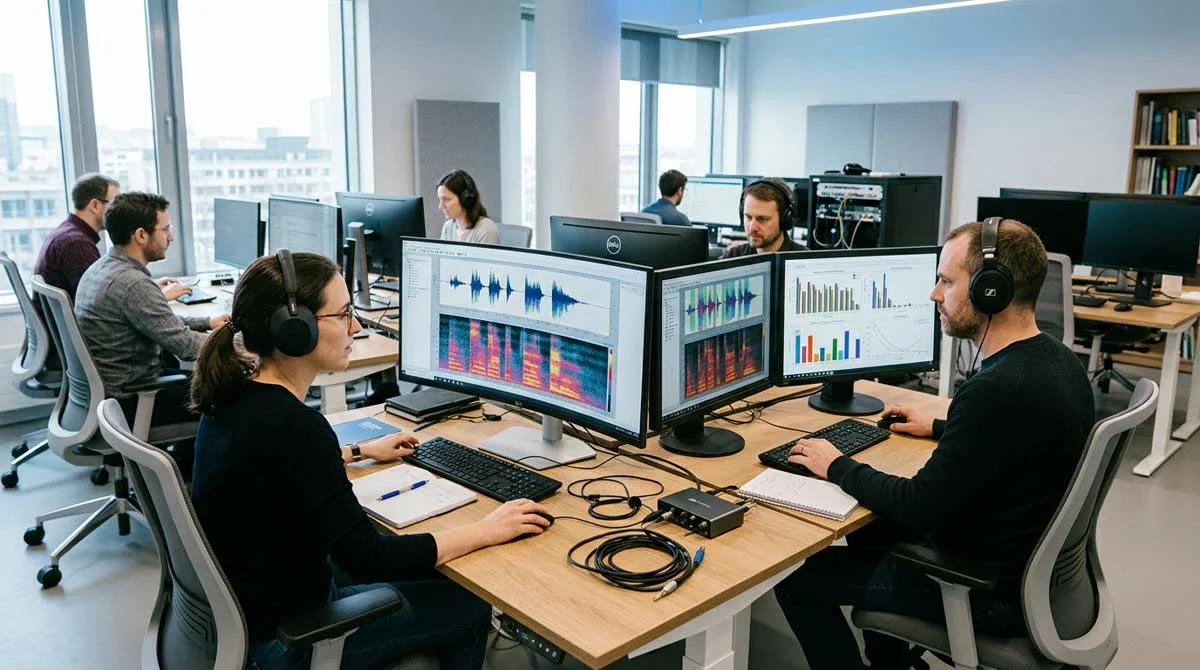
Apple confirms: speech diffusion models scale like autoregressive ones
Apple ML Research found that speech models based on continuous diffusion scale as predictably as autoregressive models, and introduced the pJSD metric.

Apple ML Research Solves ASR Model Degradation on Long Audio Recordings
Apple ML Research published the Segmental Attention Decoding method — four architectural changes that solve the main problem neural networks face when processing long audio recordings.

Apple Published Fortress — A Framework for Stabilizing Recommendation Systems Through Feature Pruning
Apple ML Research described Fortress — a system that eliminates temporal instability in recommendation models by identifying and removing features that create inconsistent predictions.

Apple ML Research investigates why AI safety data labelers disagree
Apple ML Research has developed a method for analyzing disagreements among safety data labelers — the people who train AI models to distinguish acceptable from harmful content.

Apple ML Research proposed a method for generalizing ML models to new domains without labels
Apple ML Research researchers developed an approach to domain generalization that relies on unlabeled data from a new domain instead of costly annotation.

Apple Introduced Conformal Thinking — Risk Management for Reasoning Models Without Extra Tokens
Apple ML Research presented the Conformal Thinking framework: a method that automatically manages token budgets for reasoning models, guaranteeing specified error rates with minimal computation.

Apple ML Research: how diffusion models learn to select tokens without manual heuristics
Apple ML Research proposes replacing manual token-selection heuristics in diffusion language models with learned policies to eliminate instability and the need for manual parameter tuning.

Apple ML Research proposed MemoryLLM — an interpretable “memory” for transformers
Apple researchers described feed-forward blocks in LLMs as a neural retrieval memory and proposed a method to analyze them in isolation — without accounting for the self-attention mechanism.
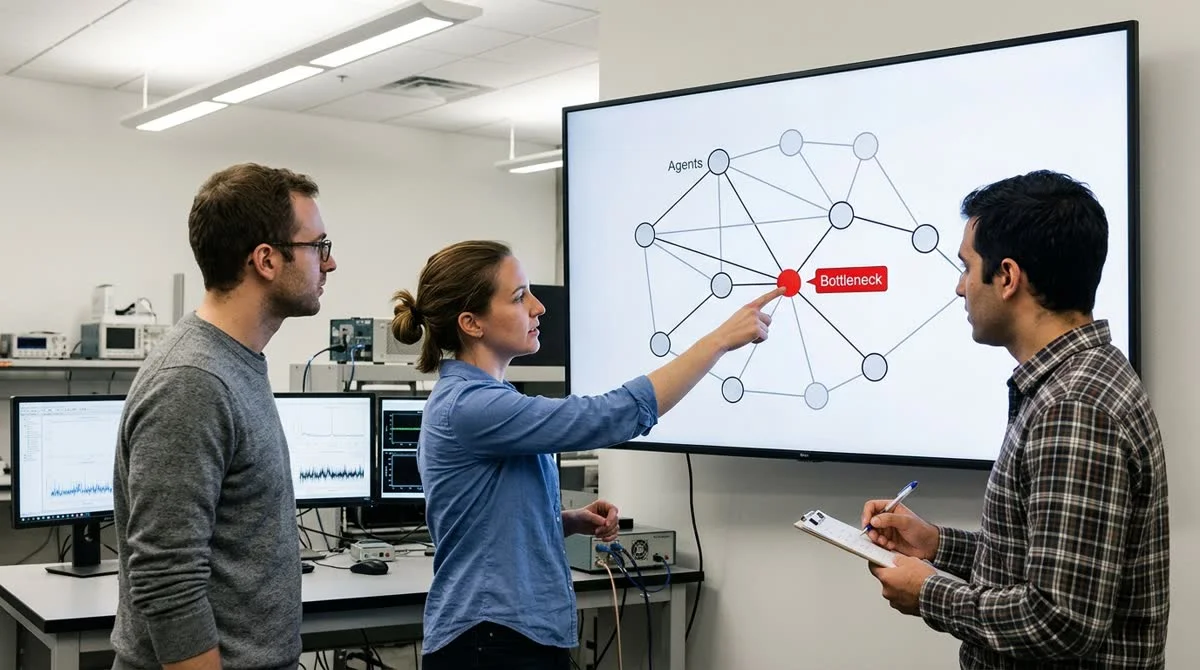
Apple ML Research: multi-agent LLM teams hold back expert agents
Apple ML Research showed that self-organizing teams of language models do not produce synergy — they hold back expert agents rather than strengthen them.