Trump for minimal AI regulation: standards needed, but as few restrictions as possible
On July 2, 2026, Donald Trump publicly outlined his position on AI regulation: certain standards are needed, but should be implemented with minimal restrictions. The main argument centers on competition with China—excessive regulations would slow American AI companies and advantage the competitor. The president did not name specific legislative initiatives.
AI-processed from Bloomberg Tech; edited by Hamidun News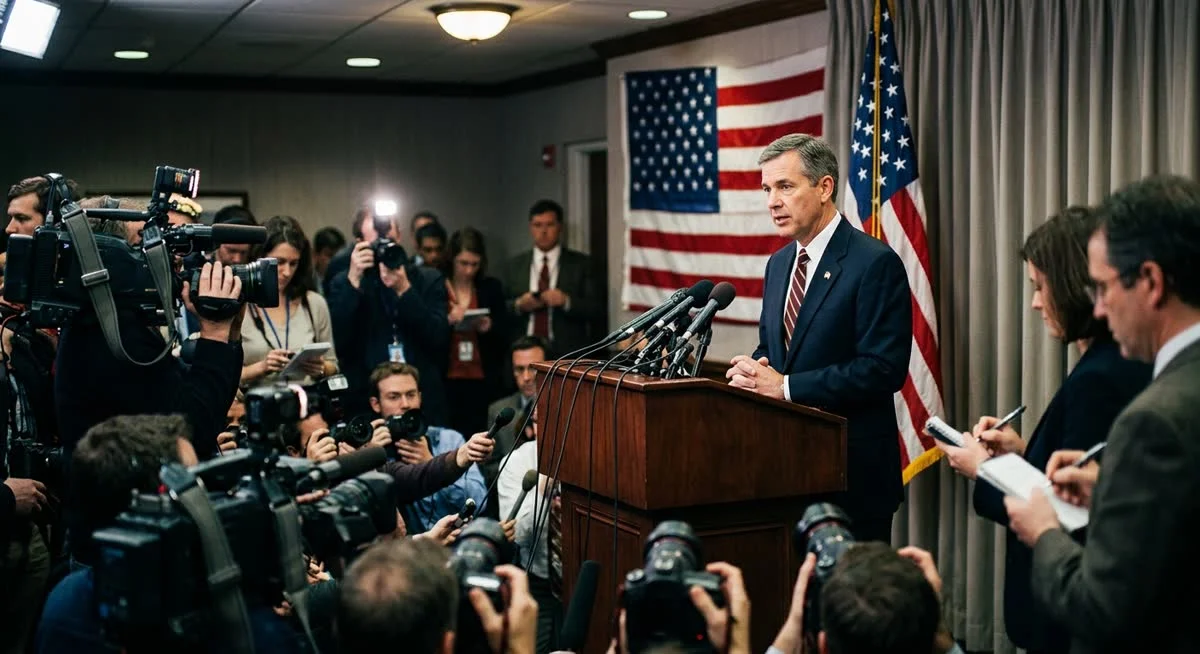
President of the United States Donald Trump stated on July 2, 2026, that he shares the need for certain standards for the AI industry, but insists on minimal regulation. According to the president, excessive restrictions could undermine the competitive position of American companies in confrontation with China.
What exactly did Trump say about AI regulation?
The president acknowledged the existence of basic AI standards, but immediately drew a red line: any rules should be minimal and not create barriers to business. In his argument, Trump deliberately avoided ethical considerations — questions of safety, disinformation, or user rights — and focused exclusively on economic logic.
The key thesis is simple: the US and China are in fierce technological competition, and restrictions that affect only the American side will inevitably give an advantage to the competitor. From this perspective, deregulation becomes an element of national strategy, rather than simply business lobbying.
Trump did not specify concrete legislative initiatives, a list of acceptable standards, or timelines.
How does this fit into the administration's course?
July's statement logically continues Trump's AI policy over the past eighteen months. In January 2025, upon returning for his second term, he signed an order canceling key AI measures from the Biden administration — including transparency requirements and mandatory safety assessments for the largest models.
On international platforms — at G7, G20, and specialized AI forums — the United States consistently avoids adopting binding multilateral standards, preferring vague voluntary declarations.
This approach fundamentally diverges from the European model. The European Union plans to systematically implement the AI Act from 2025 onwards — the world's first mandatory AI law, establishing strict requirements for developers and operators of high-risk systems. The US and EU are consistently moving in opposite regulatory directions.
The largest American AI companies — OpenAI, Anthropic, Google, Meta, Microsoft — support the minimalist course. In their view, strict federal legislation risks handing the initiative to Chinese competitors, working with state support and lesser regulatory burdens.
Why do critics consider minimal regulation a risk?
Opponents of this position point to the reverse side. The absence of mandatory standards for safety, transparency, and accountability means all these questions remain entirely at companies' discretion. Industry self-regulation, in the view of some congressmen and the academic community, is systemically insufficient.
In the history of social media, it was voluntary commitments without legislative backing that ultimately led to years of litigation and reputational crises. A number of AI researchers believe that without basic rules, an analogous scenario will unfold in the AI industry.
What does this mean?
Trump's position consolidates the situation: there will be no large-scale federal AI legislation in the United States in the foreseeable future. For tech giants — this is a predictable and comfortable environment for investment and development. For international AI regulation — a signal that no unified global standard will emerge in the coming years: the US, EU, and China are building their own, fundamentally incompatible rules of the game.
Meta is recognized as an extremist organization and banned in the Russian Federation.
Want to stop reading about AI and start using it?
AI News is a curated feed of AI/tech news. Hamidun Academy teaches you to use AI systematically in your work.
The AI world, distilled — once a week
Seven stories that actually mattered, hand-picked. No noise, no reposts, no press releases.
Done! Check your inbox for a confirmation.